
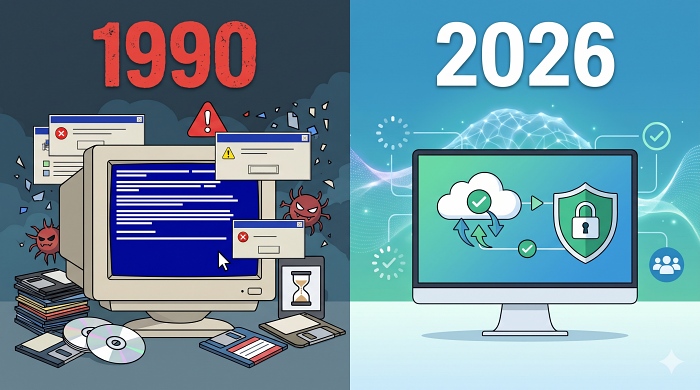
Amid criticism that today’s software environment has regressed, including a flood of copy-and-paste software driven by AI, a counterargument has emerged that “older software was much more terrible.”
Japanese IT media outlet Gigazine reported on Nov. 14 that the argument came from a blog post written on Oct. 27 by software engineer Jake Voytko (제이크 보이트코), who has used computers since 1990. Voytko challenged the view that older software was better, a view he said is based on claims of bloat, slower speeds and more bugs today.
He wrote that older software was sold on physical media such as floppy disks and CD-ROMs, making post-release fixes difficult. That required quality control, but he said there were still many problems. One example was the Windows blue screen. A peripheral driver error could freeze the entire system, and Windows itself could not fully return resources from closed apps, making it unstable over time.
He wrote that many apps lacked autosave, making it common for documents worked on for hours to be lost to crashes. Voytko said that when he joined the Google Docs development team in 2010 and analyzed user behavior, he found users often pressed Ctrl+S even though autosave existed.
He wrote that security was also weak. His younger sister, at just 9 years old, bypassed a password-protected screensaver on a store display PC by forcibly ending the task. He said ad malware could accumulate, and Word macro viruses also caused large-scale damage. Users had to defragment manually, and games designed to match CPU speeds ran too fast on faster PCs.
PC maintenance also had to be done by users. As file fragments stored on an HDD increased, read speeds slowed, requiring regular defragmentation. Modern Windows automated such processing.
He wrote that improved hardware performance could also cause problems for software. Some early PC software adjusted processing speed based on CPU operating frequency, and on PCs with faster CPUs games ran excessively fast, making them difficult to play properly.
Game design was also less developed than it is now. Diablo II, released in 2000, saw its in-game economy shaken by an item duplication bug, and players had to grab enemy-dropped items before each other. Its sequel Diablo III strengthened responses to item duplication and adopted a per-player item drop system.
Voytko acknowledged modern software bloat and rising complexity. He also said he was concerned that growing reliance on AI agents could leave developers unable to grasp internal structures. Still, he said benefits such as stability from process separation, internet updates and wider use of high-level languages that reduce mistakes are significant, and he does not want to return to past development methods.
 Hyunwoo Choo
cookinpapa@d-today.co.kr