
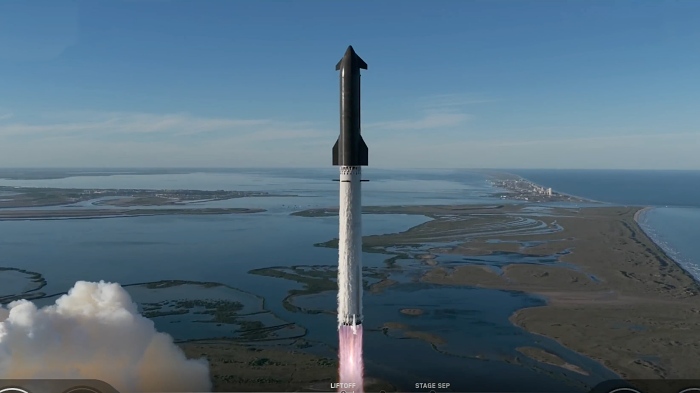
[DigitalToday reporter Hyunwoo Chu] SpaceX put the upper stage of its giant Starship rocket into Earth orbit on its 15th test flight, but scrapped plans to recover the Super Heavy booster by catching it with launch tower robot arms known as the Mechazilla tower, Space.com reported on Nov. 13 (local time).
Starship lifted off from Starbase in Texas at 5:47 p.m. that day (7:47 a.m. on Nov. 14 in South Korea). Super Heavy, powered by 33 Raptor 3 engines, pushed the vehicle upward with about 8,200 tonnes of thrust. It also completed hot-staging as planned, separating about 2 minutes 30 seconds after launch while the ship kept its engines running.
Booster recovery did not go as planned. SpaceX abandoned the catch attempt and splashed Super Heavy down in the Gulf of Mexico about 6 minutes 30 seconds after launch. The reason for the cancellation was not immediately known. If successful, it would have been the first recovery of the version 3 (V3) Super Heavy, which began flying this year. SpaceX previously recovered 3 V1 Super Heavy boosters and reused 2 of them.
Starship cruised. At 26 minutes 10 seconds after launch, it completed a second engine burn lasting about 20 seconds and entered low Earth orbit (LEO) at an altitude of about 275 km. It was the second time Starship has reached orbit, following the 14th flight on Sept. 28. SpaceX's Dan Huot (댄 휴오트) said on the launch broadcast, "Starship reached Earth orbit for the second time in history."
Starship carried 26 Starlink V3 satellites. It will deploy them in sequence from 35 minutes after launch over a 42-minute period. SpaceX explained that the cluster adds 1 terabit of data capacity to the Starlink network. That is comparable in scale to 10 launches of V2 satellites on Falcon 9. In particular, 3 of the satellites will use cameras to film Starship's heat-shield tiles and the condition of the vehicle. The data will be used as a basis for deciding whether Starship returns to the launch site.
Starship will remain in space for more than 21 hours as it circles Earth 14 times. SpaceX set 3 check points: 10 minutes after satellite deployment is completed, 7 hours 15 minutes after launch and 20 hours 41 minutes after launch. If there is a problem, it will carry out an early splashdown in the Pacific Ocean. If there is no anomaly, it will perform a 10-second deorbit burn about 21 hours 36 minutes after launch and return to Starbase at 4:17 p.m. on Nov. 14 (6:17 a.m. on Nov. 15 in South Korea). If a catch is difficult during the final approach, it will splash down in the Gulf of Mexico. If the catch succeeds, it will be the first recovery of Starship's upper stage.
Full reusability is at the core of SpaceX's business vision. Chief Executive Elon Musk said he would build next-generation Starlink with about 100,000 satellites and an orbital artificial intelligence (AI) data-center constellation 10 times that size. The goal is 10,000 Starship launches a year by 2030. Starship is also a crewed lunar lander for the U.S. National Aeronautics and Space Administration's (NASA) Artemis programme. In the summer of 2027, it is scheduled to carry out a demonstration mission in Earth orbit with the Orion spacecraft and Artemis 3 astronauts.
 Hyunwoo Chu
cookinpapa@d-today.co.kr