
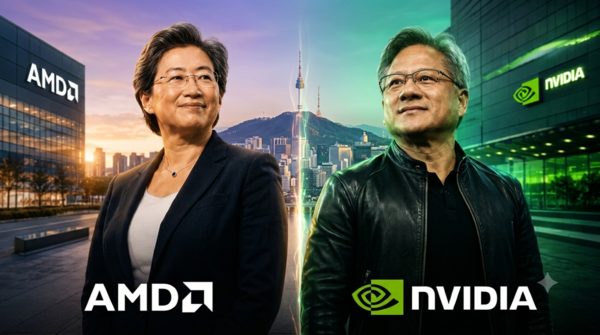
With Jensen Huang stepping down as Nvidia's former chief executive officer, attention is turning to Lisa Su, chair and CEO of rival AMD. That is because some in the industry have mentioned Su as an external candidate as the search for Huang's successor gets under way.
Business Insider reported on Nov. 13 that Su is seen as the figure who transformed AMD, once facing an existential crisis, into a global semiconductor company competing with Intel and Nvidia. When Su joined AMD in 2012, its market capitalisation was less than $2 billion, but it grew to $959.9 billion as of Nov. 12. AMD shares rose 5.86 percent that day.
Su was born in Tainan, Taiwan, and emigrated to the United States with her family as a child. She grew up in Queens, New York, graduated from the Bronx High School of Science, and earned bachelor's, master's and doctoral degrees in electrical engineering from the Massachusetts Institute of Technology. She later built research and management experience at Texas Instruments, IBM and Freescale Semiconductor. At IBM, she took part in developing technology to switch internal chip wiring material from aluminium to copper.
Huang and Su are relatives with about a generation between them rather than being close cousins. Both were born in Taiwan and moved to the United States as children, but they did not grow up together and met only after building their own careers.
◆ Lisa Su turns crisis-hit AMD into a semiconductor powerhouse
After becoming CEO in 2014, Su reshaped AMD's business strategy around high-performance computing and graphics semiconductors. She moved away from low-power, low-margin chip businesses and focused on cloud, data centres and the game console market. In the consumer market, Ryzen central processing units drove growth, while EPYC processors did so in the server market. Major cloud companies including Amazon, Microsoft and Google Cloud also adopted EPYC processors.
AMD's console semiconductor business also contributed to improving the company's fundamentals. Using a semi-custom strategy that adjusts core technology to customer demands, it won supply deals for chips for Sony's PlayStation 4 and Microsoft's Xbox One, reducing dependence on the PC market.
◆ Intensifying AI chip race presents new challenges for AMD
The competitive environment surrounding AMD is becoming more complex. Intel and Nvidia announced strategic cooperation to develop products for AI infrastructure and personal computing. U.S. semiconductor export restrictions to China are also a variable. AMD said tighter U.S. export licensing requirements in April 2025 constrained sales of its MI308 chips for China, and could result in costs of up to $800 million related to inventory and purchase commitments.
The U.S. government later allowed exports to China of some MI308 products. There were reports that the U.S. government demanded a plan to take 15 percent of revenue from permitted sales to China, but AMD disclosed that no official rules specifying such an obligation had yet been announced.
In the AI chip market, cooperation with OpenAI is cited as a new growth engine. AMD said it signed a multiyear contract with OpenAI in October 2025 and that OpenAI plans to deploy 6 gigawatts of AMD GPUs in next-generation AI infrastructure. An initial 1 gigawatt deployment of MI450 GPUs is scheduled to begin in the second half of 2026.
Su is known as a manager who responds actively even to outside criticism. After market research firm SemiAnalysis said in March 2025 that AMD's GPU software competitiveness fell short of Nvidia's, she spoke for 90 minutes the next day with the firm's chief analyst. She later said, "Feedback is a gift even when it's critical," and said she would keep improving optimisation tailored to customers and work environments.
Su was named among Time's CEOs of the Year in 2024. AMD's business scale has grown more than 100-fold since she took charge, but it still trails Nvidia, whose market capitalisation stands at about $4 trillion. With Nvidia's management succession beginning after Huang's resignation, Su's name is being mentioned as a candidate for the next top post, drawing attention across the semiconductor industry.
 Seungah Yoo
ysah@d-today.co.kr