
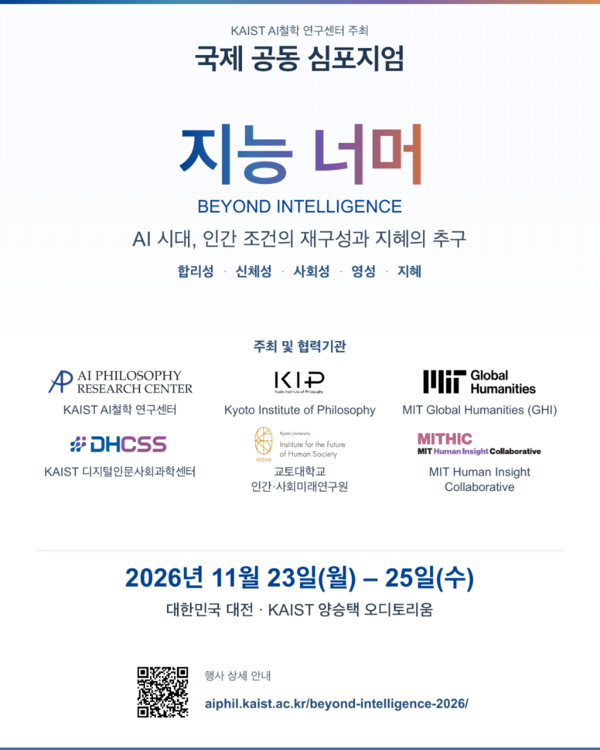
Korea Advanced Institute of Science and Technology (KAIST) will hold an international symposium to discuss humans’ roles and responsibilities as AI technology develops.
KAIST said on Nov. 13 that its AI Philosophy Research Center will hold a joint symposium from Nov. 23 to 25 at the academic and cultural complex on its main campus in Daejeon under the theme, “Beyond Intelligence: Reconstructing the Human Condition and Seeking Wisdom in the AI Era.”
The event is jointly organised by KAIST and research institutions including Kyoto University in Japan and the Massachusetts Institute of Technology (MIT) in the United States. It will examine from various perspectives how AI affects human experience and relationships and the meaning of life, beyond its technological possibilities.
Key discussion themes are 5 areas: rationality, embodiment, sociality, spirituality and wisdom. Participants will reflect on AI’s problem-solving capabilities and rationality and discuss how human bodily experience, social relationships and the meaning of life are changing.
In the embodiment track, the symposium will examine the meaning of the human body and experience as AI acts in the real world through robots and autonomous systems. In the sociality track, it will address possible changes in social norms and institutions, including roles, authority and responsibilities for humans and AI.
In the spirituality track, it will discuss values and purposes needed for a human life in the AI era. How individuals and communities should set the direction for the future will also be a key agenda item.
Participants from abroad include Yasuo Deguchi (야스오 데구치) of the Kyoto Institute of Philosophy and the Institute for Humanity and Social Future at Kyoto University, Wiebke Denecke (빕케 데네케) of the MIT Global Humanities Institute, Andre Haman (안드레 하만) of Tsinghua University, and Pak-Hang Wong (팍항 웡) of Hong Kong Baptist University.
Participants from South Korea include researchers from KAIST as well as Chung-Ang University, Pusan National University, Yonsei University, Dongguk University and Ewha Womans University. They will exchange views from a range of academic perspectives including philosophy and the humanities as well as cultural anthropology, psychology and complex systems and network science.
The event will begin with a welcome dinner on Nov. 23, followed by an opening ceremony and research presentations on Nov. 24, and research presentations and a closing on Nov. 25. A roundtable will also be held on Nov. 24, where researchers from South Korea and abroad will discuss key issues.
KAIST President Choong-sik Bae (배충식) said that no matter how much AI technology advances, the agent that decides its direction and purpose must ultimately be humans. He said he hopes the event will be an opportunity to gather the wisdom of science and technology and the humanities and jointly seek directions for AI to enrich human life.
 Jin-ho Lee
jhlee26@d-today.co.kr