
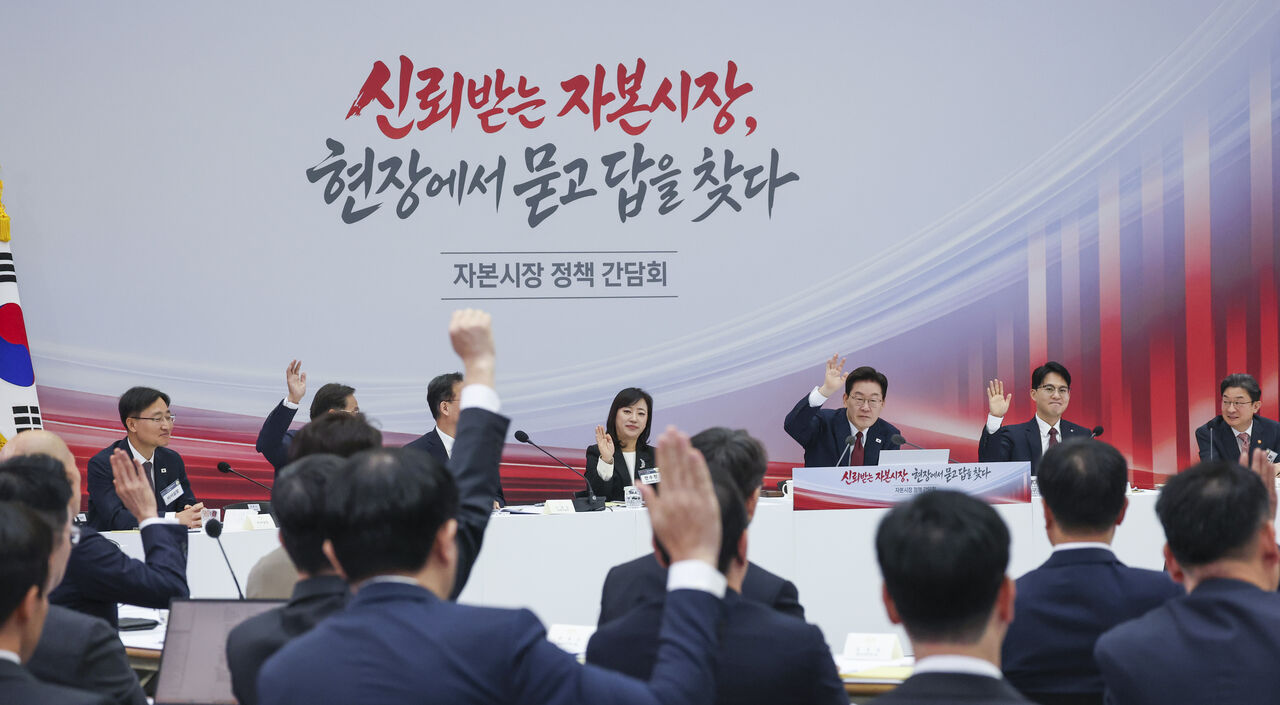
South Korean President Lee Jae-myung ordered the creation of a high-level dedicated body to normalise the domestic capital market. He aims to speed broader reforms across the capital market system, including stronger communication between listed firms and shareholders and measures to address excessive concentration of controlling shareholder stakes, while also pushing changes such as removing weak firms and activating mergers and acquisitions.
On Nov. 13, Lee told a "capital market policy meeting" at the Korea Exchange in Seoul that a dedicated body for capital market reform should have been created and pushed forcefully, adding there had been an element of complacency. He called for a high-level organisation specialised in normalising capital markets.
Lee stressed the need to intensively check capital market reform tasks separately from existing financial reform organisations. He outlined plans to form a consultative body involving not only financial authorities and the Korea Exchange but also the National Assembly and private-sector experts, designate a clear person in charge and receive direct reports on key policies.
Lee said the push should include conducting fact-finding and collecting opinions before selecting tasks. He said he would like to create a high-level organisation dedicated to the issue.
He instructed that participating institutions discuss issues on an equal footing rather than the government leading the conclusion, and that issues with conflicting views be organised and reported to him directly. The government side replied it would swiftly prepare the formation of the relevant body.
Mandatory investor relations briefings for listed firms also emerged as a key task at the meeting.
The Financial Supervisory Service and the investment industry raised concerns that Korean listed firms are passive in communicating with investors. They pointed out that companies actively provide information during the listing process but reduce communication with investors after listing, undermining market trust.
Lee Seung-woo (이승우), senior deputy governor of the Financial Supervisory Service, proposed promoting earnings calls in which companies answer shareholders' questions directly while announcing results. He said companies need to actively communicate not only current performance but also future growth outlooks and shareholder return plans.
The Korea Exchange also decided to pursue expanding IR obligations for listed firms. The plan would extend IR obligations that currently apply to newly listed companies to the entire listing period, requiring at least 1 briefing a year to explain management status and business outlook to investors.
Korea Exchange Chairman Jeong Eun-bo (정은보) said it is actively reviewing ways to make IR mandatory during the period a company remains listed. It also plans to push a measure to reflect this in listing maintenance rules.
Officials also discussed expanding English-language disclosures to improve information access for foreign investors. The exchange plans to expand mandatory English disclosures applied to the stock market and extend the system to KOSDAQ companies as well.
After hearing that domestic listed firms have poor IR performance, Lee said it was like listing, taking only the benefits and then abandoning it as unnecessary thereafter. He ordered improvements to the system.
Authorities decided to re-examine listing maintenance requirements for listed companies in which controlling shareholders hold excessively large stakes.
Lee criticised a structure in which some listed companies enjoy the benefits of being listed while controlling shareholders effectively run the business monopolistically. He said when controlling shareholder stakes reach 70 to 80 percent, it becomes effectively difficult for outside investors to acquire management control, leaving few tools to improve value even if the firm is undervalued.
Financial Services Commission Chairman Lee Eok-won (이억원) said listing maintenance conditions include stock dispersion requirements and said he would look into whether those aspects are, as Lee said, insufficient or not sufficiently activated.
Chairman Jeong also said that while companies are required to secure a certain level of shares held by general shareholders at the time of a new listing, there are cases in which controlling shareholder stakes rise again after listing.
Lee pointed to the problem of enjoying all the benefits of listing while effectively running the company monopolistically. He ordered a combined review of listing maintenance requirements and delisting standards.
He also ordered a full survey of institutional devices that block hostile M&A. The aim is to examine structural obstacles in the M&A market so that undervalued companies can be recognised at an appropriate value through contests for control.
Debate also continued over a mandatory tender offer system. A key issue is whether, when acquiring corporate control, acquirers should be required to make a tender offer for 100 percent of shares held by general shareholders, or set it at a level needed to secure control, at "50 percent plus 1 share".
Lee agreed with the principle that general shareholders should be given a fair opportunity to sell, but he stressed that if 100 percent tender offers are mandated, the M&A market could shrink due to the burden of acquisition financing and that possibility should be considered together.
Lee said he is closer to the view that even if criticised, the approach should be to increase the pie by activating M&A so the entire market is normalised and all shareholders benefit. He said, however, that the purchase ratio and allocation method for general shareholders should be decided after further discussion.
Officials also discussed delisting rules in the KOSDAQ market and the issue of inflows of long-term investment funds. Lee pointed to the problem of weak firms remaining in the market for a long time and undermining investor trust, stressing the need to raise the effectiveness of the exit system.
Financial authorities and the exchange are reviewing directions for reforming the KOSDAQ market to support the growth of strong innovative companies while swiftly removing weak firms. They also cited as key tasks a segment system that classifies KOSDAQ firms by growth potential and soundness, and expanding inflows of institutional investor funds.
In connection with a recent sharp stock market drop, officials also discussed the possibility of using a securities market stabilisation fund. Some raised the view that activating the fund is needed to ease market volatility, but the government said it must also review side effects from market intervention and actual stabilisation effects.
Lee said there is a need to re-check ways for the fund to function effectively and its appropriate size. He added that whether to activate it and the specific size have not been decided.
The government plans to organise capital market system improvement tasks and push follow-up steps based on opinions raised at the meeting. It plans to comprehensively review individual policies including information disclosure by listed firms and shareholder protection, removal of weak firms and activation of M&A.
Lee said the government will take necessary steps, whether legislative measures, administrative measures, or revising market operating rules, if needed. He said it will devote more effort than before from the government's standpoint to ensure normalisation of the stock market, financial market and capital market.
 Sangyeob Oh
yub@d-today.co.kr