
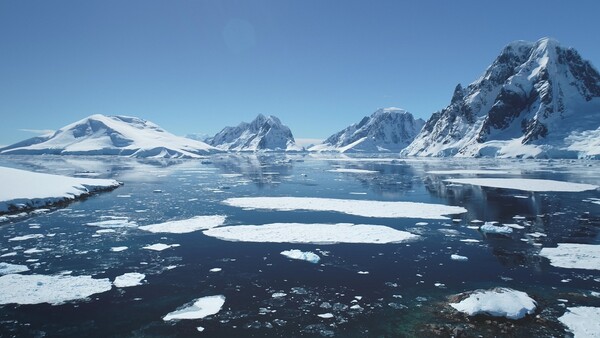
More than 300 glaciers have disappeared in the U.S. West due to climate change, and the area of remaining glaciers has shrunk 35 percent, the study showed. With the possibility that glacier loss could accelerate, concerns are also growing about ecosystems and water supplies as well as risks of natural disasters such as landslides.
Cleantechnica reported on Wednesday that a joint research team from Portland State University and the U.S. Geological Survey analysed glacier changes across six western states in the contiguous United States and published the results in the Proceedings of the National Academy of Sciences (PNAS).
In the mid-20th century, more than 1,450 glaciers existed in the western United States, with a total area of about 562 square km. Since then, more than 300 glaciers have disappeared. Total area has fallen about 35 percent, and ice volume has declined about 33 percent.
The pace of decline also differed by region. Glaciers in the Beartooth-Absaroka Range in southern Montana thinned by about 0.46 metres a year, the fastest rate. Glaciers on Mount Rainier and Mount Baker in Washington state shrank by about 0.15 metres a year, showing a relatively gentler decline.
The researchers analysed the differences as stemming from topography and climate conditions. Some glaciers in the Rocky Mountains and the Sierra Nevada remain relatively longer by sitting in shaded terrain with less direct sunlight or gaining additional snowfall from avalanches.
The outlook is also bleak. Earlier research projected that if current climate trends continue, most glaciers on Washington state's Olympic Peninsula will disappear by 2070. It also suggested that large glaciers such as those on Mount Rainier could remain until after 2100.
Glacier loss does not stop at a simple change in the natural environment. Glaciers supply cold water to rivers in summer, sustaining alpine ecosystems, and in some areas also contribute to hydropower generation.
As glaciers retreat, rocks and sediment become unstable, increasing the risk of landslides and debris flows. In 2006, roads were closed on Mount Hood and Mount Rainier after damage caused by debris flows.
The researchers warned that if glacier shrinkage continues, it could have long-term effects on ecosystems, the stability of water resources and mountain-region infrastructure in the western United States.
 Jaewon Choi
ittt_0801@d-today.co.kr