
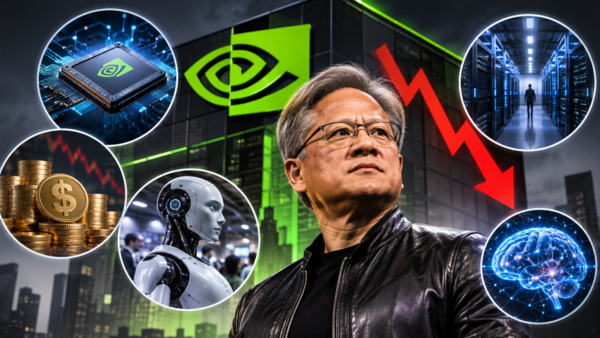
Nvidia’s former chief executive Jensen Huang (젠슨 황) has stepped down following a board decision, raising expectations that a significant vacuum could emerge across the AI industry.
On Tuesday, tech media outlet TechCrunch said the matter goes beyond a simple management scandal and could shake Nvidia’s role in driving AI policy and coordinating the industry.
The key point is that Huang has served as a leading external channel for the AI industry, beyond his role as Nvidia CEO. Nvidia has pushed multiple agendas at once, including open-weight models, safety for AI agents, AI PCs and data centre investment structures, rather than acting only as a semiconductor supplier. Huang’s exit is seen as removing the central axis that connected and drove these agendas at the same time.
First, some have raised the possibility that momentum behind open-weight models could weaken. Huang is seen as one of the most active advocates for the need for open-weight models in discussions with the tech industry and policymakers. Nvidia has provided not only its own models but also open-source technology tied to agents and AI security, and it has already agreed to acquire Hugging Face for $12.9 billion. The deal is expected to close in the first half of next year, subject to regulatory approval.
After reports in July that Anthropic and OpenAI had asked the Trump administration to ban Chinese open-weight models, Huang organised an industry-wide letter of support. Hundreds of tech companies signed it. He advanced the argument that open-weight models give companies choice and lower costs. But a key variable is that there may be no clear figure to lead this push in an organised way at the industry level going forward.
Debates on regulating AI agents could also be affected. Huang has publicly argued several times this year that, while security incidents involving AI agents have been revealed, the industry does not yet need regulation and safety issues can be solved through technology. He rallied the industry again as it was reviewing whether it needed an audit framework or a supervisory body similar to financial industry regulators. Nvidia brought together more than 100 companies to launch an Open Agent Safety Platform. The open-source-based project set out the goal of reducing problems involving agents that go out of control.
The industry’s view of AI could also change. Huang has defined AI as an engineering system that produces products and stressed it can be controlled like other engineering systems. That contrasts with a trend among some large AI labs to highlight model autonomy or the possibility of consciousness. TechCrunch said Huang’s exit would, for the time being, weaken the voice representing that opposing view.
Nvidia’s strategy in the AI PC market is also being put to the test. Huang recently persuaded several PC manufacturers to join Nvidia’s CPU strategy. He has also prepared a premium line of AI PCs that run AI agents on the device itself. The new products are due for release ahead of the year-end shopping season.
The issue is that Huang’s personal symbolism has played an important role in product marketing. TechCrunch said Huang was no longer a suitable figure to promote these devices as an alternative to the Mac mini. It said Huang’s exit introduced a variable into efforts to build awareness for the new products and into strategies to expand the market.
Confidence in AI data centre investment and financing structures could also be shaken. As a data centre construction boom continued, Huang directly designed large-scale financial structures centred on Nvidia. Critics have also raised claims that Nvidia approved circular transactions in which it supports customer expansion through equity investment and those customers then buy Nvidia chips. Citing a Bloomberg report, the outlet said the company had committed about $750 billion in such transactions through July.
In August, Nvidia decided to provide support akin to loss compensation for $105 billion in funding for an OpenAI data centre in Ohio, and in the same month major private equity firms and financial companies including Apollo, BlackRock, Blackstone, Brookfield, Goldman Sachs and KKR decided to invest up to $500 billion in data centre construction. Huang has promised that Nvidia GPUs can serve as collateral that guarantees value preservation, presenting Nvidia as “investable infrastructure”.
The issue is that Huang’s exit could affect confidence in these financing ideas themselves. Wall Street is already worried about the possibility of a sharp drop in Nvidia’s share price and the fallout, while fatigue over AI infrastructure investment has also grown. TechCrunch wrote, “Nvidia has ultimately lost its top salesman, and the AI industry has lost its strongest ‘hype man’.”
After Huang’s exit, Nvidia now faces the task of building new leadership beyond a founder-centric management system. External variables also remain, including the possibility of additional political investigations. Whether Nvidia can replace Huang’s personal influence and maintain leadership of the AI industry has emerged as a key point to watch for the industry.
 Jinju Hong
hongjj@d-today.co.kr