
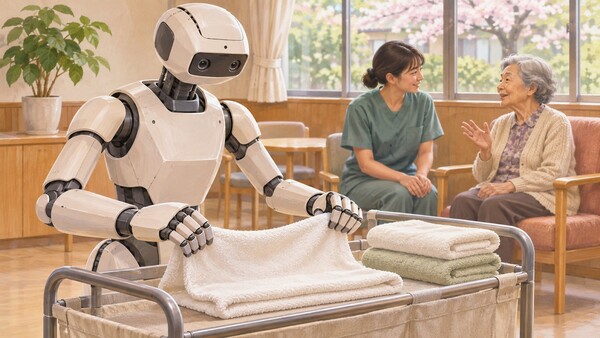
In Japan, a shortage of care workers is deepening as the population ages, and AI robots and remote monitoring systems are emerging as new alternatives. The move aims to automate repetitive tasks such as cleaning, laundry and night monitoring to reduce the burden on care workers and respond to labour shortages.
On Nov. 12 local time, Japanese media outlet ITmedia reported that Tokyo robotics startup Enactic is developing a humanoid care assistant robot, Ena. It is designed to take over ancillary tasks that account for about 30 percent of work at care sites, including cleaning living spaces, doing laundry and night monitoring.
Last month, a research facility conducted an experiment in which a robot arm took clothes out of a laundry net and folded them one by one. The robot arm can be operated remotely and also has a function that relays the force it detects when touching objects to the operator.
Enactic is working toward commercialisation in 2028. It is currently training AI to recognise various environments at care facilities, such as doors and ramps, and to move accurately.
Remote monitoring technology is also drawing attention. Technos Japan in Hyogo Prefecture developed eLive, which combines bed sensors and cameras. The system detects when a user wakes up, leaves the bed or is absent, and sends the information to a smartphone or PC.
Staff can check the situation through the camera and visit in person only when necessary. Facilities that introduced the system reported visits were cut by half and falls and drop-related accidents fell by 20 percent. This, however, is a case from individual facilities and does not indicate the overall effect of adoption.
Japan's Ministry of Health, Labour and Welfare estimated the number of care workers needed in 2040 at about 2.72 million. That is about 570,000 more than in 2022.
Low wages are also an obstacle to securing workers. In the ministry's 2025 statistics, the average monthly pay of care workers, including bonuses, is 314,000 yen (about 2,624,700 won). That is 79.3 percent of the all-industry average of 396,000 yen (about 3.31 million won).
Japan's care industry faces the task of using AI and robots to improve work efficiency while also pursuing higher wages and better working conditions.
 Jaewon Choi
ittt_0801@d-today.co.kr