
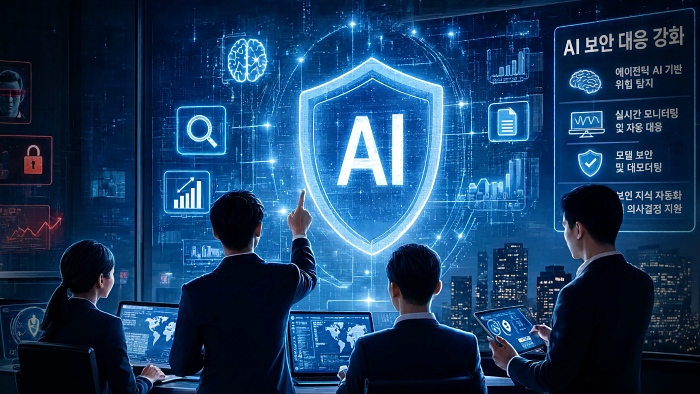
[DigitalToday reporter Chi-gyu Hwang (황치규)] As security threats around AI intensify, more AI and IT companies are moving to manage AI security directly.
LloydK, an enterprise AI search and agent platform company, launched an AI security gateway solution called DO-GATE to help companies use generative AI safely. Polaris Office is also moving to target the corporate security market by jointly running a free corporate AD security assessment campaign with affiliate Polaris AI Handy. Saltware, an AI and data platform and cloud specialist, secured a patent related to its self-developed AI security solution (AI DLP) called SafiGuardian, titled "Sensitive information detection system and sensitive information detection method," and also won supply business orders targeting financial companies. Lotte Innovate is also working with Thales to expand its AI security business.
ㆍLloydK launches DO-GATE, a generative AI security gateway solution ㆍPolaris Office makes a full push into the enterprise AI security market ㆍPolaris Office and Polaris AI Handy run a free corporate AD security assessment campaign ㆍSaltware secures a patent for generative AI sensitive information detection technology ㆍLotte Innovate teams up with Thales on AI security, unveils AI-based premium security monitoring
Large and small hacking incidents continued this week as well.
Korea’s Financial Security Institute, which supports the financial sector’s cybersecurity response, suffered an incident in which some personal information was leaked after a hacking attack. Digital certificate issuer DigiCert disclosed that it suffered a data breach in which enterprise customer contact information was leaked.
ㆍFinancial Security Institute information security assessment site hacked, raising concerns about financial company data leaks ㆍFinancial Security Institute breached by hacking, dealing a blow to policy execution and the 20th anniversary FISCON ㆍDigiCert reports enterprise customer information leak after an internal system exposed to the internet was breached
The United States and France pointed to Iran as being behind cyber attacks targeting refrigeration and freezing equipment at European supermarkets.
ㆍU.S. and France: Iran is behind the hacking of European supermarket refrigerators
With hacking incidents surging as AI spreads, the government is also moving in earnest to prepare countermeasures. The National AI Strategy Committee launched a "National Cyber Resilience Strengthening Task Force" to bolster the ability to maintain and restore national critical infrastructure and essential services in preparation for cyber attacks. The Ministry of Science and ICT will strengthen security for internet of things (IoT) products such as IP cameras. Following hacking incidents involving refrigeration and freezing equipment control systems in Europe, including France, the ministry inspected the security status of South Korea’s cold-chain industry and also recommended emergency security measures. Financial authorities will raise the security level of digital asset operators to that of financial companies. They plan to include in the digital asset law obligations to ensure information technology (IT) safety and liability for damages, and to allow preemptive blocking of deposits and withdrawals if hacking is suspected even before the law takes effect.
ㆍNational AI Strategy Committee launches a task force to strengthen cyber resilience ㆍMinistry of Science and ICT responds to IP camera hacking risks, steps up security checks of manufacturers and distributors ㆍMinistry of Science and ICT strengthens response to cold-chain hacking, recommends emergency security measures for domestic companies ㆍFinancial Services Commission moves to tighten security at digital asset exchanges to financial company levels
The Ministry of Science and ICT will conduct an ex officio investigation into an intrusion incident involving GS E&C’s apartment community facility reservation and management system. GS E&C reported an intrusion incident that occurred on Oct. 29 in its apartment community facility reservation and management system. The company, however, said it would analyze the incident on its own and did not agree to investigations by the ministry and the Korea Internet & Security Agency (KISA).
ㆍMinistry of Science and ICT to launch an ex officio probe into GS E&C hacking incident, challenging its plan for an internal investigation
Japan’s government is considering introducing blocking that would forcibly block access to certain websites to prevent further spread of personal information leaked in cyber attacks, reports said.
ㆍJapan to pursue internet blocking to cut off sites leaking personal information at the source
The article also summarised moves and issues involving domestic and overseas companies related to security.
Cisco will integrate Anthropic’s security-focused model, Claude Mithos 5, into its AI security solution AI Defense. JPMorgan Chase, the largest bank in the United States, will adopt OpenAI models for software development and cybersecurity. As AI use expands from routine task support tools to core IT system development and security work, changes are expected in competition over AI adoption in the financial sector. Japan’s SoftBank will strengthen group-wide security checks following a ransomware incident at its subsidiary IDC Frontier. With advances in AI speeding up cyber attacks and vulnerability discovery, the company judges that limits have emerged in traditional manpower-centred response systems.
ㆍCisco deploys Mithos 5 in its AI security service, strengthens red-team testing capabilities targeting AI ㆍBanks hand security to AI as JPMorgan Chase joins hands with OpenAI to expand technology use ㆍ"Vulnerabilities never end" as Japan’s SoftBank strengthens security response
Global runtime application security company RAVEN officially announced its entry into the South Korean market. RAVEN’s strategy is to target companies subject to strong regulation first.
ㆍRuntime application security company RAVEN enters South Korea, targets regulated industries first
API governance specialist Softfreak will launch a solution called F-Avata Shell within this year that automatically generates vulnerability diagnosis scripts using AI. PnP Secure supplied a visual hacking (screen information leakage) prevention solution called FaceLocker to a South Korean savings bank. Private AI signed a general agency agreement with Jin Infrastructure to expand sales channels for enterprise security solutions.
ㆍSoftfreak develops F-Avata Shell to automate AI-generated vulnerability diagnosis scripts ㆍPnP Secure supplies a screen information leak prevention solution to a South Korean savings bank ㆍPrivate AI signs general agency deal with Jin Infrastructure to expand AI security channels
ITCEN Group’s security-focused company ITCEN PNS is strengthening full-cycle security response capabilities, from vulnerability discovery to risk analysis, preemptive defence, real-time detection and automated response, as part of efforts to advance AI-based vulnerability diagnosis and threat response capabilities. KT will provide an "AI email security" service to the Korea Advanced Institute of Science and Technology (KAIST) to strengthen the university’s overall email security system. BNK Financial Group is checking the cybersecurity response system across all affiliates and is moving to introduce AI-based vulnerability management and build a 24-hour integrated security monitoring system.
ㆍITCEN PNS strengthens AI-based security response capabilities, focusing on vulnerability and threat intelligence analysis ㆍKT provides AI email security to all KAIST members to strengthen cyber threat response ㆍBNK Financial conducts special inspections of security systems across all affiliates, introduces AI-based vulnerability management
Following Artrex, attacks using another AI-based penetration testing platform, Antifox, are also increasing. Recently, Antifox was also used in attacks that stole Amazon Web Services (AWS) authentication information and penetrated internal systems, reports said.
ㆍAI penetration testing platform Antifox also under alert, used in attacks targeting AWS
As demand for AI grows, hacking focused on stealing computing power is spreading, in a different vein from attacks aimed at personal information or extorting money through ransomware. Unlike cryptojacking, which gradually siphons off others’ computing resources, LLMjacking differs in that it generates large usage fees over a short period. In some cases, fraudulent usage fees exceeded $100,000 in a single day, and some companies said cumulative damage reached $1 million before they blocked unauthorised access.
ㆍAn "underground economy" in AI expands as access to computing power stolen in hacks is bought and sold
 Chi-gyu Hwang
delight@d-today.co.kr