
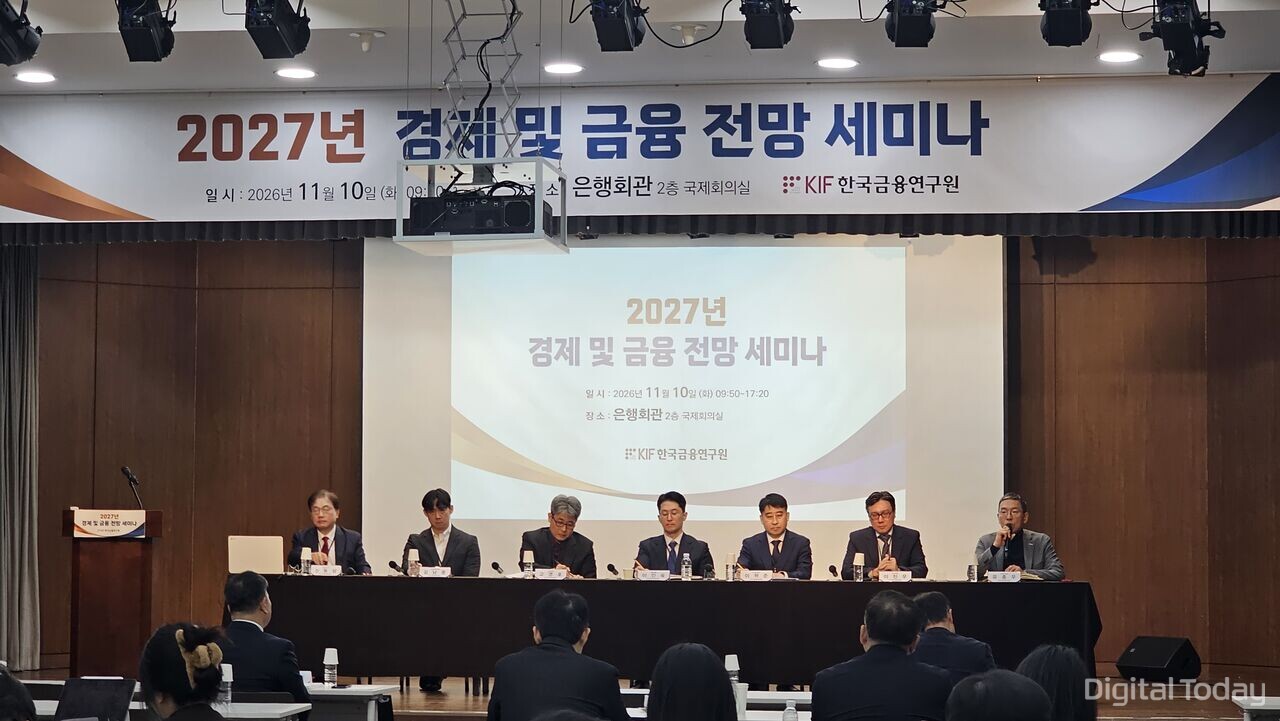
South Korea's stock market in 2027 is expected to remain uncertain through the first half due to the semiconductor cycle and foreign investor flows, before gradually stabilising from the second half, a forecast showed.
On Nov. 10, Kim Nam-jong (김남종), head of the capital markets research division at the Korea Institute of Finance, presented a base-case scenario at a seminar on the 2027 economic and financial outlook that semiconductor supply shortages and a boom could continue in 2027. He analysed that a stock market structure concentrated in semiconductors, foreign selling and a high balance of margin loans could amplify volatility. He also cited whether non-semiconductor sectors recover earnings as a key variable for a stock price rebound.
The financial investment industry is expected to continue growing around large firms. He analysed that inflows of retirement pension funds and the expansion of capital-based businesses such as integrated management accounts and short-term notes could work in favour of large brokerages and asset managers, deepening polarisation in the industry.
Kim also cited the persistence of growth in the AI semiconductor industry, a recovery in foreign investment demand, and volatility in stock, bond and currency markets as key variables across financial markets next year. He forecast that uncertainty over the scale of cash flow generation from AI investment and the financial soundness of large technology companies could affect markets.
INVESTMENT BANKS SEE KOSPI REBOUND; FINANCIAL REGULATOR CHECKS MARGIN LOANS, SIDECAR
A panel discussion that followed addressed the possibility of a rebound in South Korean stocks and the financial authorities' response to market volatility.
Yoo Jong-woo (유종우), head of research at Korea Investment & Securities, presented 8,280 points as his KOSPI forecast for next year. Yoo said, "Given the situation is moving around 5,000 now, we are looking at a very big upside," adding, "That assumes a rebound in the share prices of Samsung Electronics and Hynix."
He said share prices could rebound if expectations for the semiconductor cycle remain, but took a cautious stance on whether Samsung Electronics and SK Hynix shares can rise further beyond their previous highs.
Lee Jin-woo (이진우), head of research at Meritz Securities, also presented a scenario in which the KOSPI recovers to around 8,700 points in the first half of next year. On the recent market pullback, Lee said, "It corresponds to a shock comparable in intensity to the collapse of a bubble or a crisis," but stressed the need to focus on the earnings power and fundamentals of domestic companies.
He said that for the semiconductor-led investment cycle to continue, demand centred on business-to-business transactions needs to expand into business-to-consumer demand.
Financial authorities stressed the need to review risk management systems to respond to heightened market volatility.
Lee In-wook (이인욱), director at the Financial Services Commission's market analysis division, said, "Going forward, it seems necessary to expand the scope of risk checks beyond existing risk factors such as internal concentration of funds in financial markets and leverage, to include the impact of cash flows in general industries and individual companies on financial markets and financial firms."
He said that while the past analysis mainly focused on risks to the financial sector from banks' funding supply by company and industry, it will now also be necessary to examine the reverse impact of industrial and corporate cash flows on financial markets.
Ko Young-ho (고영호), a director at the Financial Services Commission's capital markets bureau, cited prospects for the AI semiconductor industry, interest rate changes and the demand base for domestic stocks as key factors that will determine future market volatility.
Ko said, "In policy goals, there is an aspect of managing volatility. So it is true that we are watching margin loans closely."
He said the authorities are also reviewing the effectiveness of the sidecar system, which temporarily halts program trading during sharp stock market moves. Ko said, "We are also taking a look at what the sidecar's usefulness is," adding, "We are checking whether the system instead increases volatility due to a learning effect and are reviewing improvement measures."
SAVINGS BANKS TO STAY CONSERVATIVE NEXT YEAR, FOCUS ON SOUNDNESS MANAGEMENT
In the outlook for non-bank deposit-taking institutions that day, a view was presented that efforts are needed to reset business strategies in a changing regulatory environment.
In particular, a view was raised that while the savings bank industry saw improved growth and profitability in the first half of this year, loan soundness could be a concern if interest rates rise going forward.
The savings bank industry is expected to focus on asset soundness and risk management next year, rather than aggressively expanding business.
At the discussion, Lee Kyung-yeon (이경연), an executive at the Korea Federation of Savings Banks, said, "The business environment will not be favourable next year either due to a real estate downturn, household loan management, weakened borrowers' repayment capacity, and higher funding costs from a base rate hike," and forecast that an increase in interest income through active loan expansion will be limited next year.
He added, "We strengthened loss-absorbing capacity and shifted into a profitable phase through preemptive provisioning and capital increases this year, but it is hard to see it as a full-fledged improvement in performance, so this kind of conservative lending operation stance will continue."
However, he said, "We will faithfully carry out the inherent function of a people's finance institution by securing new growth engines next year, and for that we plan to diversify the portfolio and move actively on people's finance and consumer protection."
 Ji-young Lee
ljy@d-today.co.kr