
South Korea's Ministry of Science and ICT discussed ways to implement its "K-Moonshot" strategy to solve national science and technology challenges using AI. It reviewed the AI environment needed to deliver research and development results and checked tasks to improve institutions and infrastructure.
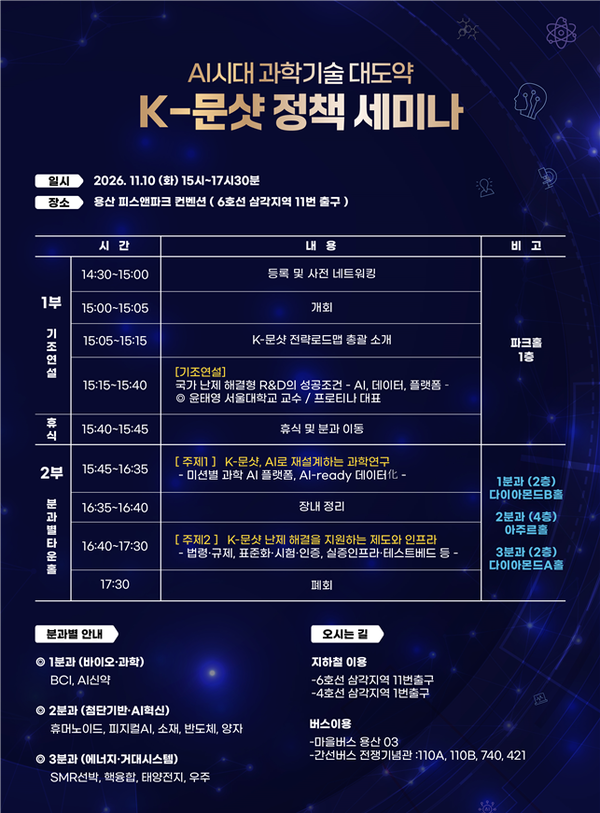
The ministry held a "K-Moonshot Policy Seminar" on Nov. 10 at Peace & Park Convention in Seoul. The event was arranged to support smooth implementation of the "K-Moonshot Strategy Roadmap" approved at the ministerial meeting on science and technology-related affairs in September.
K-Moonshot is a policy and R&D programme to boost national science and technology competitiveness through AI-based scientific research. It will be pushed around consolidating national science AI resources and 12 national missions. The 12 missions are new drugs, brain-computer interface (BCI), solar cells, nuclear fusion, small modular reactor (SMR) ships, humanoids, physical AI, space, materials, AI scientists, semiconductors and quantum.
Each mission will be driven around a lead conductor (PD), an expert in each field. PDs appointed in June drew up mission-by-mission strategic roadmaps containing detailed implementation plans.
K-Moonshot will also take on the role of resolving scientific and technological challenges needed for seven SEED projects, including SMRs, nuclear fusion, renewable energy, quantum, aerospace, advanced bio and advanced supply chains, to grow into large R&D projects.
The seminar discussed building an AI-based research environment and steps for institutional support. In the first session, Tae-young Yoon (윤태영), CEO of Protina, delivered a keynote speech on "Conditions for success of R&D that solves national challenges: AI, data, platforms."
In the second session, industry, academia and research experts held a discussion on tasks to consider during implementation of the K-Moonshot strategy roadmap. Participants split into three divisions - bio and science, advanced foundation and AI innovation, and energy and large-scale systems - and discussed ways to spur research innovation by using data and AI models, computing resources and science AI platforms.
Dae-hyun Oh (오대현), director-general for Future Strategy and Technology Policy at the ministry, said, "The government will do its utmost to support researchers as they pursue national missions with a sense of duty, so that obstacles do not arise in areas such as AI use and institutions and infrastructure."
 Jin-ho Lee
jhlee26@d-today.co.kr