
Market interest rates are expected to remain high next year as inflation pressures keep the possibility of monetary tightening alive, an outlook showed. Inflation is expected to keep rising above the price stability target despite an economic recovery led by a semiconductor boom. Experts urged authorities to check banks’ loss-absorbing capacity and focus policy efforts on financial market stability to prepare for rising delinquency risks among self-employed borrowers and marginal firms vulnerable to higher rates.
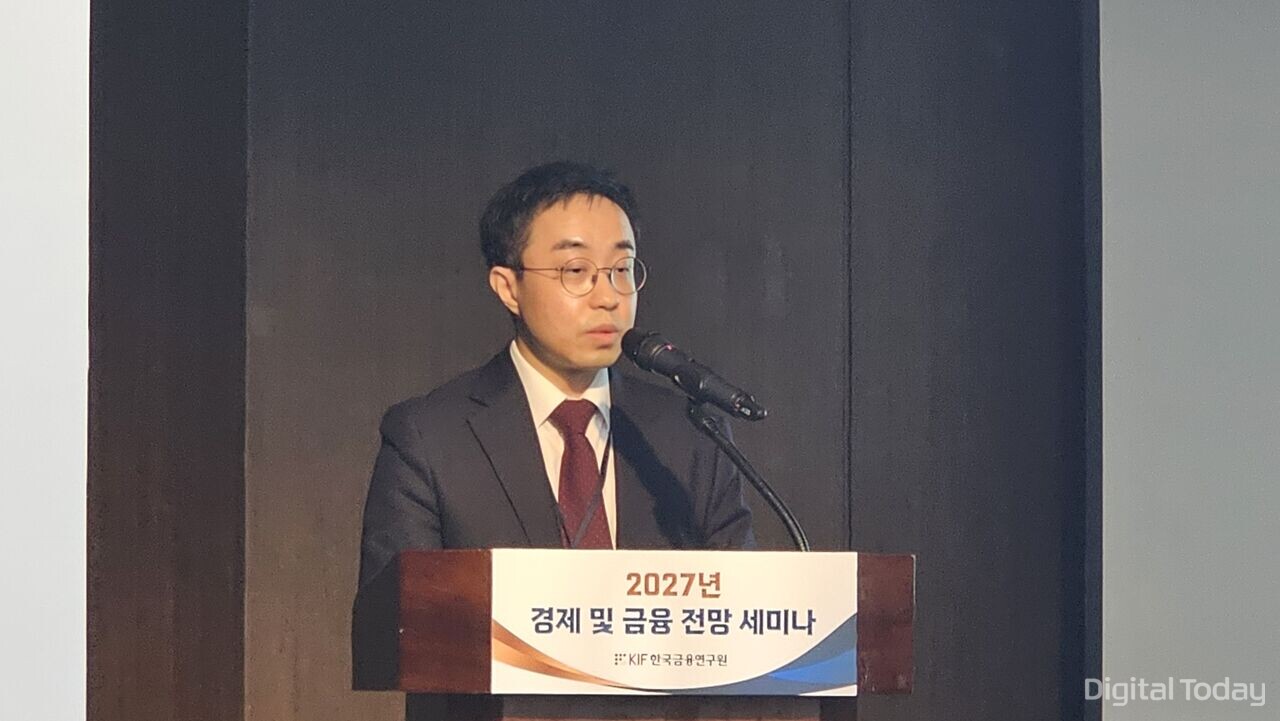
At a “2027 Economic and Financial Outlook Seminar” hosted by the Korea Finance Institute at the Korea Federation of Banks building in central Seoul on Nov. 10, Kim Hyun-tae (김현태), head of its macroeconomic research division, forecast the average annual yield on three-year government bonds at 4.1 percent next year. That would be 0.4 percentage point higher than this year’s estimated 3.7 percent.
Kim said the possibility of additional hikes in the policy rate could affect market interest rates, given inflation pressures from the boom in semiconductor exports and the prolonged war in the Middle East. He also said further gains in market rates are likely to be limited because expectations for policy-rate hikes have already been largely priced in and the volume of government bond issuance is expected to decline next year.
On the Bank of Korea’s policy-rate outlook, he said the median dot plot as of February 2027 stands at 3.25 percent, suggesting one additional hike. He also presented an analysis that financial markets expect one or two future policy-rate increases.
He stressed that the future path of monetary policy could vary depending on moves in international oil prices and domestic core inflation.
Next year’s inflation seen at 2.4 percent; tightening pressure persists as domestic demand recovers
The institute forecast next year’s consumer inflation at 2.4 percent. That would be lower than this year’s estimated 2.7 percent, but still above the Bank of Korea’s 2 percent inflation target.
It said this year’s inflation was driven by supply shocks from a weaker won and geopolitical instability in the Middle East, while demand-side inflation pressure is expected to grow next year due to the economic recovery and an expansion in domestic demand.
In particular, it said its recent analysis splitting inflation into demand and supply factors shows that demand-side factors have contributed more since the second half of the year due to strong exports and improving economic conditions. It said demand pressure is also having a bigger effect on services and goods prices than supply pressure, and that inflation driven by the recovery could last for a considerable period.
It also pointed to accumulating pressure to raise public utility charges due to higher international oil prices as an upside risk to inflation. It said that because public utility price hikes have been limited compared with rising costs, accumulated cost burdens could be reflected in prices if high oil prices persist.
“Monetary policy should focus on stabilising inflation expectations while staying alert to inflation pressures stemming from an expansion in domestic demand,” Kim said. “In particular, if inflation expectations continue to rise or service prices and wages show broader increases, pre-emptive policy responses are necessary,” he added.
Concerns over delinquency risk at vulnerable borrowers and marginal firms as rates rise
It forecast that vulnerable economic players will continue to face difficulties even as the economy recovers. It said that while a boom in semiconductor exports is lifting corporate profits and household income, the benefits of the recovery are not spreading evenly across industries and income groups.
It said the self-employed, in particular, are facing heavier operating cost burdens such as raw material costs and rents, alongside intensifying competition due to an increase in individual business owners, delaying improvements in business conditions.
It said the number of vulnerable self-employed borrowers and the share of vulnerable borrowers in outstanding loan balances are also gradually rising. It warned that if the high-rate environment persists, financial vulnerability could expand further as the burden of principal and interest repayments increases.
It recommended that financial policy should prioritise market stability in response to rising rates and heightened geopolitical risks, while focusing on soundness management in vulnerable sectors and efficient credit allocation.
Kim stressed that banks should check their loss-absorbing capacity and strengthen response systems to prepare for a negative scenario in which energy prices rise further and the semiconductor cycle turns down at the same time. He said there is also a need to prepare in advance for a heavier repayment burden among vulnerable borrowers due to rising rates and for a widening risk of delinquency among marginal firms.
The institute forecast the economy will grow 3.1 percent next year, supported by strong semiconductor exports, an expansion in facility investment and a recovery in private consumption. It said that would be lower than this year’s estimated 3.8 percent growth, but would extend growth in the 3 percent range for a second straight year.
It said a growth structure concentrated in semiconductors means changes in investment conditions for artificial intelligence (AI) could affect not only exports and investment but also domestic demand. It stressed that policy responses are important in a situation where recovery and the burden of high rates coexist, as it will take time for benefits from the semiconductor boom to spread across the broader economy.
In the discussion, Kim Young-joo (김영주), head of the Macroeconomic Forecasting Division at the Bank of Korea’s Research Department, said he broadly agreed with the institute’s outlook and major risk factors but stressed the need to pay closer attention to upside risks to inflation next year.
“In addition to cost pressures from higher international oil prices, income growth and a recovery in domestic demand could translate into demand pressure,” Kim said. “If performance bonuses and wage increases at semiconductor companies spread to other industries, they could act as a factor raising core inflation,” he added.
From the perspective of financial stability, he cited credit risks and financial market volatility stemming from an adjustment in global AI investment as key risk factors. He also cautioned about the burden on vulnerable sectors from rising rates.
“Unlike the boom in the semiconductor industry, the self-employed and others whose business conditions have not improved may struggle under high interest rates, so we should continuously monitor the soundness of vulnerable sectors and risks of financial imbalances,” he said.
 Ji-young Lee
ljy@d-today.co.kr