
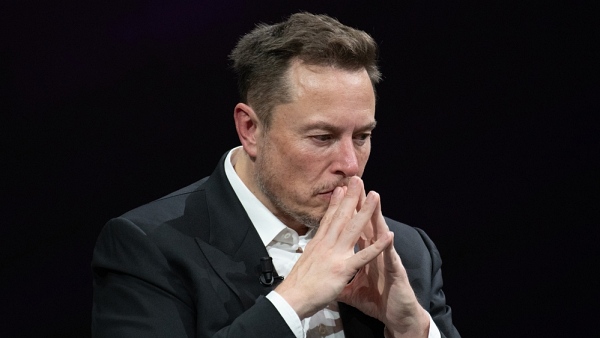
Elon Musk (일론 머스크) predicted a future in which advances in artificial intelligence (AI) and robots sharply reduce the scarcity of goods and services.
On Nov. 9, Business Insider reported that Musk, speaking by video at Baron Capital’s annual conference, envisioned an era in which digital superintelligence meets all human demand.
Musk, the chief executive of Tesla and SpaceX, said, "Superintelligence will satisfy every human desire," adding, "Whatever you want, digital superintelligence can make it." He said the shift would change the economic structure itself.
Musk has argued that combining AI, robotics and energy technology can lower costs and raise productivity, significantly expanding the global economy. He again predicted that digital superintelligence could double white-collar productivity and rapidly grow the global economy by 20 to 30 percent.
He also said humanoid robots could be 5 times as productive as humans. He said robots can work faster and can operate 24 hours a day without needing vacations, bathroom breaks or meals. He estimated that 20 million to 30 million robots could match the output of the current U.S. workforce.
He also mentioned the distribution structure of a future society. Musk said that once superintelligence emerges, the current economic system would be seen as outdated, and the monetary system would look like the way seashells were once used as money.
On local backlash over AI data centres, he cited SpaceX’s Memphis operation as an example. He said criticism is growing over water and power use and noise, but argued that SpaceX’s presence alone is energising the Memphis economy. He said restaurants are full, hotels are sold out and tax revenue is increasing.
Still, Musk’s outlook has long been accompanied by scepticism. He previously said AI could make wealth meaningless, weakening the importance of building assets for old age, and has mentioned government cash payments as a response to job losses. Those remarks have sparked debate over how feasible such ideas are in practice, separate from technological optimism.
Similar projections continue across big tech and the AI industry. Bill Gates recently said AI would bring an era of abundance, with robots able to build homes, grow food and even handle healthcare. He warned, however, that the process could be a highly turbulent transition lasting 20 years. Dario Amodei, CEO of Anthropic, has also said AI could improve everyone’s quality of life but that unprecedented turmoil could come first.
Against that backdrop, Musk’s remarks again showed he views AI not as a simple automation tool but as infrastructure that changes scarcity itself. The outlook presented in the original text is being raised alongside concerns that technological development could clash with employment, distribution and local communities, and the pace of any industrial transition is expected to be a key point to watch.
 Yoonseo Lee
yslee@d-today.co.kr