
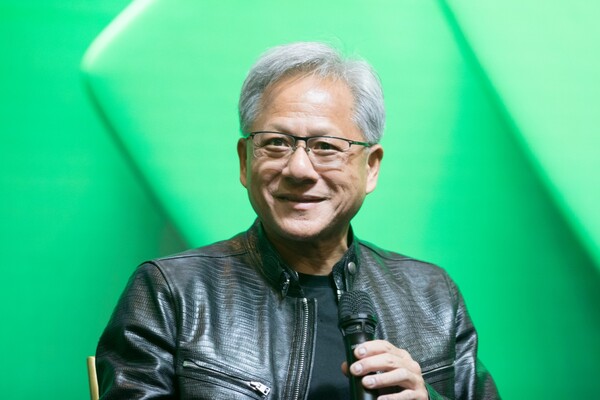
Nvidia shares tumbled on allegations tied to CEO Jensen Huang (젠슨 황) and the fallout from a board investigation, stoking concerns about the company’s governance and succession planning. Investors are watching not only whether the allegations are true but also how long Nvidia can maintain a management structure seen as relying on Huang alone.
On Nov. 9, CNBC and Decrypt, among other foreign media outlets, reported Nvidia shares fell as much as 8 percent intraday and its market capitalisation at one point dropped by about $350 billion. News that Nvidia’s board had launched an independent investigation into Huang weighed on investor sentiment.
The probe stems from a New York Times report that Huang has a private relationship with a company executive whom U.S. intelligence authorities suspect is linked to China’s Ministry of State Security. In a message to employees, Huang acknowledged he had not been faithful to his spouse and apologised, and said he would cooperate with the investigation. However, there has been no confirmation that Huang leaked classified information or intentionally cooperated with a foreign intelligence agency. Nvidia’s board also expressed trust in Huang, saying there was no reason to believe national security or company secrets had been compromised.
Even so, the market’s sensitivity reflects Nvidia’s heavy reliance on Huang. Huang, 63, is a co-founder who has helped build Nvidia into a core semiconductor company during the spread of generative AI over the past 4 years. Inside and outside the company, he has been deeply involved in overall management as chief executive and president. About 60 people report directly to him, and he has served as Nvidia’s public face at meetings with national leaders and at industry events.
The problem is that there is no clear No. 2 to replace him. Melius Research said in a report, “Nvidia’s problem is that there is no clear successor to CEO Huang.” Bernstein’s Stacey Rasgon also effectively equated Huang with Nvidia and said the company is run through a top-down structure centred on him. Huang continues to run the company during the investigation, but investors worry business continuity would inevitably be hit if the matter worsens and leads to his departure.
The share weakness is not explained by the controversy alone. Nvidia’s market capitalisation had already shrunk sharply to about $4.51 trillion on Nov. 6 from about $5.78 trillion on Oct. 6. With doubts persisting over the sustainability of AI infrastructure investment, news of the investigation added to the burden. On the same day, the S&P 500 and Nasdaq rose 1.48 percent and 1.87 percent, respectively, and other semiconductor stocks also gained, suggesting the market was focusing on Nvidia-specific risks rather than the broader sector.
Political pressure is also growing. Republican U.S. lawmakers demanded a closed-door briefing related to Nvidia’s security procedures, and Democrats said they plan investigations and legislation to prevent advanced AI chips from being diverted to China. As Huang has argued Nvidia must sell semiconductors to Chinese customers as well, there is speculation the controversy could affect negotiations with the U.S. government.
Nvidia’s governance is also under scrutiny. Huang’s stake is slightly above 3 percent of outstanding shares, and he is one of 11 board members and is not the formal chair. The company has previously said in disclosures that long-term business success could be undermined if it fails to have a succession plan for key executives and a smooth management transition. Nvidia has technology executives including Chief Technology Officer Michael Kagan and senior scientist Bill Dally, but the market sees it as difficult for them to fully replace Huang’s role.
Ultimately, the key issue is both the board investigation’s findings and whether Nvidia can reduce its reliance on Huang. Investors are also expected to check at the quarterly earnings announcement scheduled for Nov. 17 whether growth in the AI business is being maintained. Huang’s future has not been decided, but the episode is seen as putting Nvidia’s management continuity and succession system to the test as it leads the global AI semiconductor market.
 Jinju Hong
hongjj@d-today.co.kr