
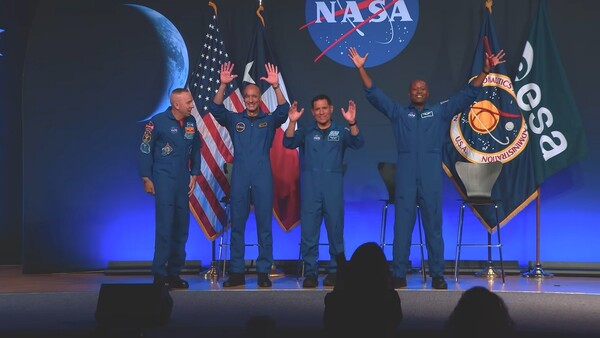
NASA has opened recruitment for new astronaut candidates for the first time in two years. The move aims to secure personnel to prepare for exploration of the moon's south pole and construction of a lunar base, and, in the longer term, crewed exploration of Mars.
Business Insider reported on Nov. 9, local time, that NASA began accepting applications for next-generation astronaut candidates on Nov. 7. The recruitment is the first since 2024, and the application deadline is Dec. 3.
NASA Administrator Jared Isaacman (재러드 아이작먼) said those selected could walk on the moon's surface and live or work at a future lunar base. He also said they could participate in developing systems and operational frameworks needed for crewed Mars exploration.
Eligibility requirements are strict. Applicants must be U.S. citizens with a master's degree in science, technology, engineering or mathematics and at least 3 years of work experience in a related field. A medical degree, completing at least 2 years of a related doctoral program, or completing certified test pilot training are also recognized as ways to meet the degree requirement. Pilots can meet the work experience requirement through flight experience.
The selection process evaluates judgment, leadership, teamwork and communication skills as well as expertise. Applicants must pass a security background check, drug testing, vision and physical exams, mental health evaluation and an underwater survival test.
Final selectees will train for about 2 years at NASA's Johnson Space Center in Houston. They will learn to carry out tasks including spacewalks, space station operations, flying high-performance aircraft and controlling robotic arms. The job posting lists an annual salary of $164,395, or about 220.62 million won, and says applicants must accept irregular working hours and that remote work is not allowed.
Competition is also intense. NASA received more than 8,000 applications in its 2024 recruitment, but selected only 10 candidates in 2025.
NASA plans to announce the final successful candidates for this recruitment in late 2027 and to begin training between winter that year and early the following year. Selection as a candidate does not guarantee assignment to an actual moon or Mars mission.
This recruitment is seen as a step to expand the human foundation needed for the goals of the Artemis program, which involves long-term stays on the moon, and for future Mars exploration.
 Jae-won Choi
ittt_0801@d-today.co.kr