
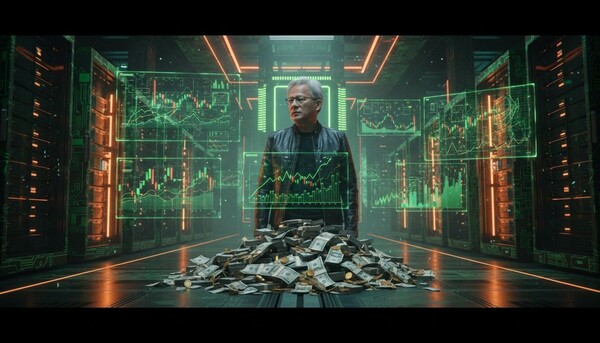
Allegations involving Nvidia CEO Jensen Huang, including an affair and suspected links to Chinese intelligence agencies, are shaking Silicon Valley, but are not expected to significantly affect the AI industry’s growth, an analysis said. It also said U.S. AI companies could benefit if the episode reduces Nvidia’s semiconductor supply to China.
On Nov. 9, Business Insider reported that Wall Street is focusing on how the issue could affect Nvidia’s management stability and the supply of high-performance semiconductors, rather than AI demand.
The analysis said it is unlikely AI developers would stop using Claude Code or Codex because of Huang’s private-life controversy, or that users would abandon ChatGPT, which is used by 1.2 billion people each week. Companies are also unlikely to halt AI adoption aimed at cutting costs and boosting productivity. It also said Western companies may choose models from U.S. companies such as Anthropic or OpenAI instead of Chinese open-weight AI models.
Brian Colello (브라이언 콜렐로), a senior equity analyst at Morningstar, said he expects substantial growth potential for AI chipmakers and rising computing demand. He said Nvidia’s outlook that annual AI infrastructure investment could reach $3 trillion to $4 trillion by 2030 will be realised regardless of the episode.
Still, uncertainty over Nvidia’s management could become a variable in the chip supply market. Nvidia leads the market for high-performance AI chips, and Huang has played a key role in building its current position. If Huang steps down as CEO, disruptions could emerge in the company’s business strategy, relationships with key customers and fundraising. A possible probe by U.S. politicians is also a burden factor.
Nvidia shares fell 4 percent on Nov. 9, while rival AMD surged 13 percent. The market is seen as reflecting the possibility that some AI semiconductor demand could shift to rivals as uncertainty grows over Huang’s future.
The possibility of reduced semiconductor supply to China is also in focus. Allegations have emerged over whether overseas data centres of Nvidia customer Megaspeed were used to provide Nvidia chips to Chinese customers while evading U.S. export controls. If such transactions become more difficult because of the episode, Nvidia’s sales of graphics processing units in China could be effectively restricted.
That could instead be an opportunity for U.S. big tech companies. If chip volumes that had been headed to China are supplied to the U.S. market, Amazon, Microsoft and Google, which are pouring huge funds into building AI data centres, could benefit. It is uncertain, however, whether increased supply would lead to actual price declines.
Questions were also raised over whether Huang’s lobbying to expand semiconductor sales to China was driven by Chinese influence. Stacy Rasgon (스테이시 래스건), a semiconductor analyst at Bernstein, said Huang has worked for years to sell Nvidia products in China and did not appear to need separate encouragement.
U.S. intelligence authorities are also reported to have judged that Megaspeed executive Alice Huang was recruited into intelligence activity for China. This is not a confirmed fact, and Nvidia’s board has said it sees no basis to conclude that company secrets or national security were compromised. The board is investigating the related allegations.
Colello maintained his fair-value price target for Nvidia at $310 and also suggested the episode could end without much impact. The analysis said the AI industry’s growth ultimately depends more on technology demand and the ability to build supporting infrastructure than on a specific CEO’s private life.
 Seung-a Yoo
ysah@d-today.co.kr