
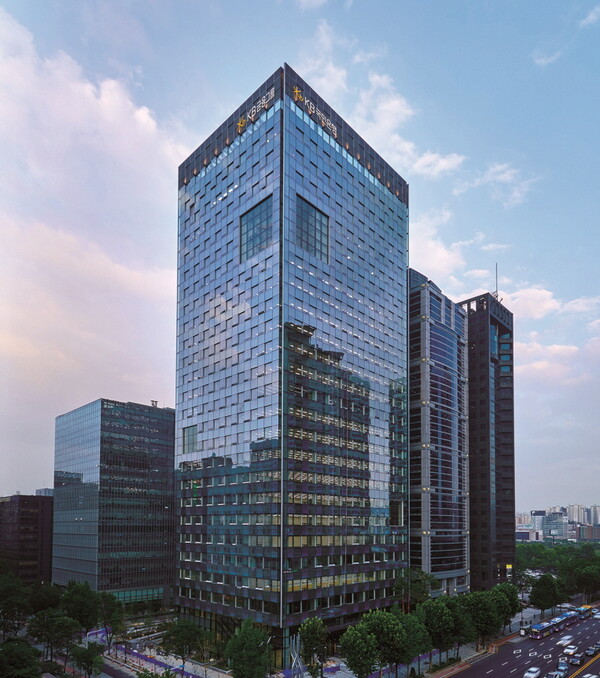
KB Financial Group posted close to 5.8 trillion won in net profit for the first nine months, helped by higher fee income at its securities and banking units. Expanded corporate lending at the bank and earnings growth at non-bank units, combined with cost efficiency efforts, led to a double-digit rise in net profit from a year earlier. Third-quarter net profit fell from the previous quarter as weaker stock trading value and higher market rates reduced non-interest income.
KB Financial said on Wednesday its nine-month net profit rose 13.1 percent from a year earlier to 5.79 trillion won. Third-quarter net profit was 1.91 trillion won, down 4.3 percent from the previous quarter.
Accumulated fee income jumps 38.5 percent; third-quarter non-interest income falls
Nine-month net interest income rose 2.9 percent from a year earlier to 9.99 trillion won. An expansion in bank loan assets, centred on corporate lending, and funding cost management such as attracting low-cost deposits contributed to the increase in interest income.
Third-quarter net interest income rose 11.6 percent from the previous quarter to 3.51 trillion won. The group net interest margin (NIM) was 1.92 percent and the bank NIM was 1.72 percent, each down 0.02 percentage points from the previous quarter. Funding costs rose as volatility increased in funding markets despite improved loan asset yields.
Accumulated net fee income surged 38.5 percent from a year earlier to 4.09 trillion won. Securities brokerage and bank fees related to financial investment products increased, and fee income in the card and lease segments also rose.
In particular, securities fee income rose 150.2 percent from a year earlier to 1.30 trillion won. Trust income increased 92.6 percent to 718.7 billion won, while foreign exchange fees and lease fee income rose 34.1 percent and 7.5 percent, respectively.
Third-quarter net fee income fell 29.7 percent from the previous quarter to 1.13 trillion won. Fees at the bank and securities units declined due to lower stock trading value. Quarterly net fee income fell but remained above 1 trillion won for the fourth straight quarter.
Accumulated non-interest income rose 27.3 percent from a year earlier to 4.76 trillion won. Third-quarter non-interest income fell 42.9 percent from the previous quarter to 1.13 trillion won. Declines in gains and losses related to securities and trading and derivatives, driven by higher rates and increased stock market volatility, weighed on results.
KB Kookmin Bank nine-month net profit at 3.58 trillion won; KB Securities up 114.9 percent
KB Kookmin Bank, its main unit, posted nine-month net profit of 3.58 trillion won, up 6.3 percent from a year earlier. Asset growth centred on corporate lending and cost management supported the improvement.
Third-quarter net profit rose 20.1 percent from the previous quarter to 1.35 trillion won. As of end-September, won-denominated loans totalled 391 trillion won, up 3.5 percent from end-2025. From the end of the previous quarter, household loans rose 0.9 percent and corporate loans increased 2.0 percent.
Among non-bank units, KB Securities showed a notable improvement. KB Securities posted nine-month net profit of 1.07 trillion won, up 114.9 percent from a year earlier. Higher trading value driven by an active capital market and increased fee income in its wealth management (WM) business supported results.
KB Securities' third-quarter net profit was 271.2 billion won, down 177.3 billion won from the previous quarter. The rise in capital market-related fee income slowed due to increased stock market volatility and lower trading value.
KB Insurance posted nine-month net profit of 681.1 billion won, down 11.2 percent from a year earlier. Underwriting profit increased on improved loss ratios in general insurance, but investment gains and losses fell due to increased volatility in market interest rates and the exchange rate.
KB Kookmin Card posted nine-month net profit of 331.7 billion won, up 51.1 billion won from a year earlier. Higher revenue from increased card spending and growth in instalment financing, along with easing burdens from selling and administrative expenses and provisions, supported results.
KB Life's nine-month net profit was 210.6 billion won, down 17.3 percent from a year earlier. Weak insurance sales due to a shrinking pension market and valuation losses on bonds and alternative investment assets weighed on results.
Cost efficiency improves; CET1 at 13.80 percent, quarterly dividend at 1,167 won
The group's nine-month general and administrative expenses totalled 5.36 trillion won. Costs increased due to securities performance bonuses and education tax burdens, but the cost-income ratio (CIR) improved by 0.8 percentage points from a year earlier to 36.4 percent.
Accumulated credit loss provisions totalled 1.58 trillion won, down 98.9 billion won from a year earlier. The accumulated credit cost ratio (CCR) was 0.40 percent, down 0.06 percentage points from a year earlier. The group non-performing loan (NPL) ratio was 0.69 percent and the NPL coverage ratio was 129.3 percent.
The group's accumulated return on equity (ROE) was 13.89 percent, up 1.11 percentage points from a year earlier. Return on assets (ROA) was 0.93 percent. As of end-September, the common equity tier 1 ratio (CET1) was 13.80 percent and the Bank for International Settlements (BIS) capital ratio was 16.02 percent.
KB Financial will also continue its shareholder return policy. The board decided a third-quarter cash dividend of 1,167 won per share. That was 237 won higher than a year earlier, with total dividends of 404.9 billion won.
Na Sang-rok (나상록), executive vice president and chief financial officer at KB Financial, said, "Even as uncertainty persists in financial markets, KB Financial is maintaining stable profit growth by proactively responding to market changes based on balanced profit generation across the bank and non-bank segments."
 Lee Ji-young
ljy@d-today.co.kr