
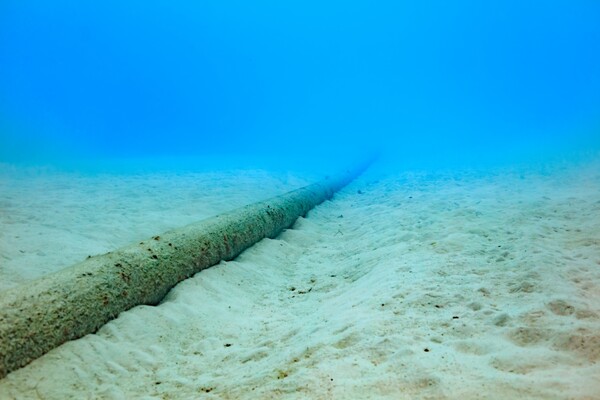
The European Union has formalised a plan to build the first subsea internet cable directly connecting Europe and Greenland.
According to IT outlet Ars Technica on Oct. 28 local time, the EU said in a new Arctic strategy document it would support a “sovereign, secure and resilient subsea cable connection that directly links Greenland to the EU.”
The project, called the Pan-Arctic Cable, also includes an option to extend to Asia via Canada. The European Commission wrote that like-minded partners such as Canada could serve as a stepping stone for a future expansion into Asia. It also includes a plan to ultimately connect to Japan and South Korea. A feature of the route is that it does not pass through the United States.
The plan is tied to Europe’s geopolitical response, beyond a communications infrastructure project. Elisabeth Braw assessed that the fact the idea is being considered is itself a “sign of the times.” She noted that a project that did not appear highly commercial 5 years ago has now become a subject of official discussion.
Europe’s search for a new route reflects geopolitical risks tied to existing subsea cables. According to TeleGeography, more than 90 percent of communications between Europe and Asia depend on subsea cables passing through the Red Sea. But open fighting between Yemen’s government and the Houthi forces resumed this year, undermining the safety of merchant shipping in the Bab el-Mandeb Strait and the Red Sea area and increasing the burden of cable maintenance and repairs.
The Pan-Arctic Cable took shape after European companies and research institutions and a Greenland telecommunications operator signed a development agreement in 2025. The EU then supported the project through the Connecting Europe Facility Digital program. Under the new strategy document, it has already invested $119 million, or 107 million euros, to strengthen Greenland’s secure and sovereign connectivity.
Obstacles remain before construction. Extending the cable via Canada to South Korea and Japan would require greater icebreaker capacity to support installation and maintenance in Arctic waters covered by ice. Proposals for a Pan-Arctic cable have surfaced several times in the past, but none progressed smoothly. The Arctic Connect project, which aimed to link Europe and Asia along Russia’s Arctic coast, was halted in May 2021.
Europe is also strengthening its response to subsea network security. The new Arctic strategy includes a plan to establish an Arctic Cable Hub to monitor, protect and support recovery of subsea cables in the North Atlantic-Arctic waters. It also said it would invest in smart technology to detect potential threats early.
The moves coincide with a recent series of threats to subsea infrastructure. In the Baltic Sea, incidents have continued in which vessels linked to Russia and China are suspected of dragging anchors and cutting European subsea cables. In the spring of 2026, there was also an example of NATO member-state forces confronting a Russian submarine that was conducting training to disable subsea cables in Arctic waters near Norway.
Braw said that in the past companies rarely considered geopolitics when choosing cable routes, but now they must also weigh international relations and the risks of surveillance and sabotage. She said more cables would be built to connect friendly countries, and that route design avoiding the exclusive economic zones or territorial waters of unfriendly countries would become important in the process.
Separately, Europe is also reviewing additional new subsea networks focused on friendly countries, beyond the Greenland route. Norway’s Bulk Infrastructure Group began seeking a Canadian partner in September 2026 to take a large stake in a new transatlantic cable directly linking Europe and Canada, called the Leif Erikson system. It shows that Europe’s subsea cable strategy is shifting to reflect security and alliance structures, not only speed and cost.
 Jinju Hong
hongjj@d-today.co.kr