
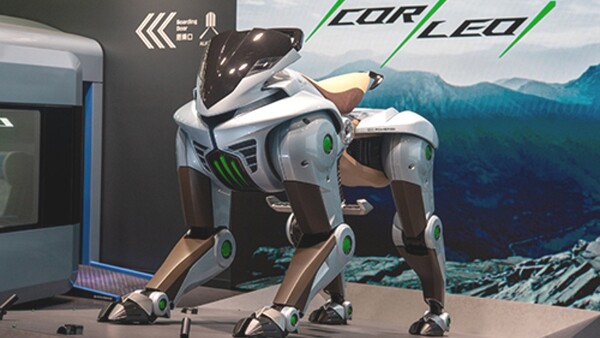
[DigitalToday reporter Choi Jae-won] Japan's Kawasaki Heavy Industries is pushing to commercialise CORLEO, a quadruped walking mobility device that can carry a person and travel along mountain paths, by 2035. It was initially a concept model envisioning transport in 2050, but it moved toward actual product development after drawing more interest than expected.
On Oct. 29 local time, Japanese media outlet ITmedia reported that Kawasaki Heavy Industries is running CORLEO as a project reporting directly to the CEO and has begun full-scale development.
CORLEO is a mobility device with four legs attached to a body that evokes a lion’s torso. One adult rides it like a horse and controls direction by shifting the rider’s centre of gravity. It is powered by electricity produced by a hydrogen engine.
The unit unveiled last year at the Osaka-Kansai Expo is a full-scale mock-up. A unit that can actually carry a person and travel across mountainous terrain is still in development.
Development began about 2 years ago during work to conceptualise a future mobility device. Ideas such as a motorcycle that does not fall over and a flying car were considered, but the development team decided to remove wheels to differentiate it from existing cars and motorcycles.
The team also struggled over how many legs to use. It judged six and eight legs would evoke insects, and two legs would be difficult to distinguish from humanoids. It ultimately chose a four-legged structure, considering a familiar appearance, stability and the ability to handle terrain.
The developers also went into real mountains and crawled on all fours. That was to experience firsthand where to place legs on rough terrain.
The biggest tasks for commercialisation are safety and ease of operation. Kawasaki Heavy Industries is validating movement based on human-designed models rather than leaving all movement to AI. It uses AI to respond to various environments such as rain and wind.
The company plans to complete a ride simulator in 2027 and unveil a new unit, CORLEO X-1, at the Riyadh Expo in Saudi Arabia in 2030.
In 2035, it will push commercialisation with a focus on tourism and leisure. It is also considering restricting operating areas and conditions at first and offering the public opportunities to ride through dedicated experience facilities.
 Choi Jae-won
ittt_0801@d-today.co.kr