
[DigitalToday reporter Chi-gyu Hwang] "We will achieve a 40 percent share of overseas revenue in 2028 and 50 percent in 2030."
Hancom, one of South Korea’s leading software companies, set out ambitious numerical goals as it moves to target the global market with AI-native SaaS.
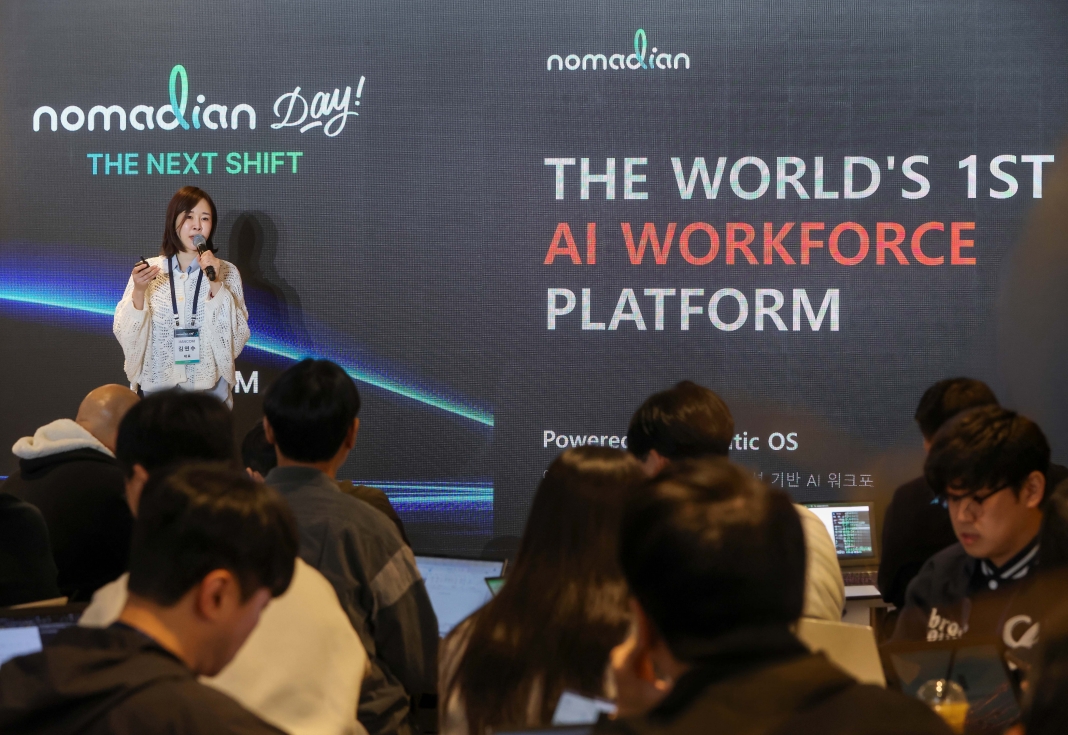
Hancom held a press briefing on Wednesday morning at Hancom Tower in Pangyo, Seongnam, Gyeonggi Province. It introduced Nomadian, a cloud-based AI workforce platform aimed at global markets, and shared its strategy.
Hancom CEO Yeon-su Kim (김연수) said Nomadian’s target for paying customers in 2028 is 250,000. "The United States is only the starting point, and the stage is the global market, so these are conservative numbers," he said, showing confidence.
According to the company, Nomadian is a service targeting small businesses and solo founders. Users can build AI teams by role such as sales, marketing and research in a 3D workplace. It supports business owners in running a company while managing these teams. Role-based AI teams divide up company roles and responsibilities and perform tasks based on Hancom’s agentic OS and document solutions.
Users can choose a team leader and select agents to create a marketing or research team. There are 12 types of default team members. When the user gives instructions, the leader agent assigns tasks to member agents. The user decides which tasks require approval and which can be handled automatically. Repetitive tasks can be saved as workflows and run 24 hours a day, and outputs are delivered as webpages, videos and PDF documents. Pricing is expected to be around $40 per person.
According to the company, Hancom will formalise its entry into the U.S. in November at Amazon Web Services’ headquarters in Seattle and start a local beta service in December. It will launch a global commercial version in March next year.
Nomadian is drawing attention because it is an AI-native SaaS developed separately rather than AI added to Hancom’s core office software, and because it is targeting global markets from the start rather than starting in South Korea and expanding abroad.
Kim made clear at the briefing that Nomadian is not a product rushed to market.
He said the company has spent more than 10 years building a foundation to provide software as a platform, including software development kits, application programming interfaces and the Model Context Protocol. He said Nomadian is an extension of that effort.
Kim said the company started as an office software firm 36 years ago, but its revenue structure and overall focus have shifted significantly toward AI. He said it declared this year that it would become an agentic OS company based on know-how gained from operating AI solutions and agents, and changed its name from Hangul and Computer to Hancom. "We decided we needed a global service targeting B2C beyond B2B, which is why we introduced Nomadian," he said.
"If we first build a service targeting South Korea, we would have to rework it for global use, so it is a priority to be validated in global markets from the start," he added. "A Korean-language service will be introduced in line with the global commercial launch."
Introducing Nomadian, Kim pointed to Meta’s personal AI agent and Salesforce’s AI agent platform Agentforce as comparisons. He stressed the company worked to differentiate the product in anticipation of competition with companies that already have strong name recognition.
At the briefing, participants cited differentiation points including that Nomadian is an R&R (Roles and Responsibilities)-based platform targeting small businesses and solo founders, unlike Muse used by individuals or Agentforce focused on enterprises, and that it has a lock-in effect that makes it difficult for users to leave once they start using it. "Nomadian is structured to become more personalised to the user’s way of working the more it is used," Kim said. "We will target the small and medium-sized business market, where churn is high, by leading with personalisation capabilities."
"In Nomadian, users can visually 확인 which agents are working and which agents are producing errors," he added. "With gamification elements, 3D character-based AI agents can evolve from level 1 to level 6. At around level 3, they can understand a user’s management style and propose tasks first."
Hancom will focus on targeting the global small business market, including the United States, with Nomadian. In the United States, the company said, there are more than 30 million businesses operated without employees. Kim said it set 5,210,000 of those that actually use AI as a first target. "We plan to enter a closed beta service in December, and about 500 companies will participate," he said.
Hancom is also actively cooperating with various tech companies to target the U.S. market. It is working with Amazon Web Services on establishing a market entry strategy and with TaskUs on customer support. B2B tech agency VisualFizz will handle Nomadian marketing, and ClickIT will run 24-hour service operations.
 Chi-gyu Hwang
delight@d-today.co.kr