
The government is pushing to introduce fund-type retirement pensions under which financial companies set up separate trustee corporations to manage subscribers' retirement pension assets. With a system in which the existing contract-based model and the fund-type model operate together, competition among financial companies including securities firms over the retirement pension market, which has exceeded 500 trillion won, is expected to intensify.
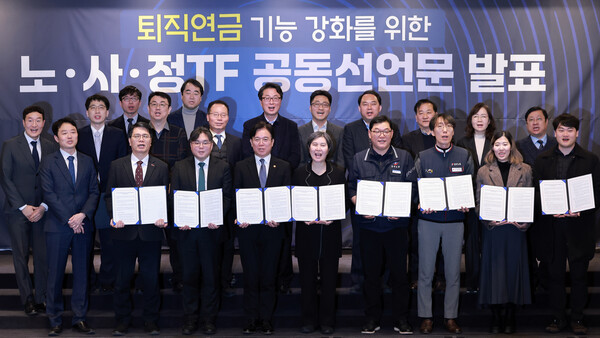
The government on Oct. 29 announced a joint inter-agency plan to strengthen retirement pension functions after a ruling party-government consultation by the Climate, Energy, Environment and Labor Committee. The plan fleshes out directions presented in a joint labor-management-government declaration in February. Key measures include making external funding of retirement benefits mandatory for all workplaces and promoting fund-type retirement pensions.
The retirement pension market is growing quickly. As of end-2025, accumulated funds stood at 501.4 trillion won, up 16.1 percent from 431.7 trillion won a year earlier, surpassing 500 trillion won for the first time.
The annual return last year was also 6.47 percent, the highest since tallying began. The share of investment in performance-linked products rose to 24.6 percent last year from 6.9 percent in 2015.
The government judged that despite market growth, gaps among workplaces in adoption of retirement pensions and low long-term returns remain problems. Over the past 10 years, workplace adoption of retirement pensions stayed around 26.5 percent, and last year's retirement pension return of 6.47 percent was lower than the National Pension Service's 18.82 percent, the Government Employees Pension's 17.2 percent and the Korea Teachers' Pension's 18.9 percent.
It will first make it mandatory in phases for all workplaces to place retirement benefits outside the company with financial companies and other external entities.
If an amendment to the Worker Retirement Benefit Security Act passes within this year, the external funding requirement will expand after a one-year preparation period. It would start in 2028 for workplaces with 100 or more employees, then extend in 2029 to workplaces with 10 to 99 employees and in 2030 to workplaces with fewer than 10 employees.
To reduce the burden on small and medium-sized companies, the government will provide matching support for reserves to workplaces that adopt the system early. It will also support loan costs for operating funds for newly adopting workplaces. It also plans to apply special retirement pension fee provisions to workplaces with fewer than 30 employees.
The part drawing attention from the financial investment industry is fund-type retirement pensions.
Unlike the existing contract-based model in which subscribers choose products directly, the fund-type model pools reserves and is managed by a trustee corporation with expertise. Profits and losses belong to subscribers. It applies to defined-contribution plans and IRPs, and a single workplace can operate both contract-based and fund-type models at the same time.
In particular, a "financial institution open" model will be introduced, allowing financial companies, alone or as a consortium, to set up separate for-profit trustee corporations to manage retirement pensions for multiple workplaces. It will also be divided into an association model run by multiple employers or labor-management groups, and a public institution open model run by public institutions.
The minimum capital requirement for a financial institution open trustee corporation is set to be 12 billion won. Trustee corporations must obtain preliminary approval and full approval, and will also be subject to fiduciary duties prioritising subscribers' interests and liability for damages.
For securities firms, this effectively opens a path to expand their business from selling existing retirement pension accounts and products to fund management through separate trustee corporations. With mandatory external funding likely to increase the amount of money entering retirement pensions, competition among financial companies over performance, products and pension platforms is expected to intensify.
Investment regulations for contract-based retirement pensions will also be eased.
IRPs can currently invest only up to 70 percent of total reserves in risk assets, but the government decided to raise the cap in stages in consideration of market size and volatility. Whether to raise the risk asset cap for defined-contribution plans will be reviewed later.
The range of eligible investment products will also expand. It will newly include comprehensive investment management accounts and securities firms' promissory notes as eligible investments, which are currently unavailable for investment in defined-contribution plans and IRPs. This is an area where expansion of securities firms' promissory note and IMA businesses could be linked to the retirement pension market.
Default options will also be overhauled again, focusing on returns and risk-adjusted performance. The government will evaluate about 320 products and review measures to stop new subscriptions or remove products with low performance. It also plans to bring forward the timing of guidance on default option application to two weeks before maturity from four weeks after maturity, to reduce the period funds remain at low interest rates.
Evaluation of retirement pension providers will also shift from qualitative assessments to a focus on quantitative indicators such as returns, long-term retention and pension receipt. It plans to disclose evaluation results more objectively rather than only publishing some top providers, to encourage competition among providers.
The government plans to prepare an amendment to the Worker Retirement Benefit Security Act in November and push for its passage at a National Assembly plenary session in December.
Choi Jong-jin (최종진), head of the pension innovation division at Korea Investment & Securities, said, "From the worker's perspective, expanding the means to participate actively in the capital market will be a turning point for improving returns." He said intensifying competition from introducing fund-type retirement pensions could also provide a positive stimulus to the existing contract-based market and create new opportunities for securities firms.
Choi added, "It is positive that easing IRP risk asset investment limits and expanding investment products are being pursued, but whether to expand the risk asset investment limit for defined-contribution plans remains a task for later review." He added, "Given the aim of building long-term retirement assets, we hope related system improvements for defined-contribution plans will be made swiftly."
 Sang-yeop Oh
yub@d-today.co.kr