
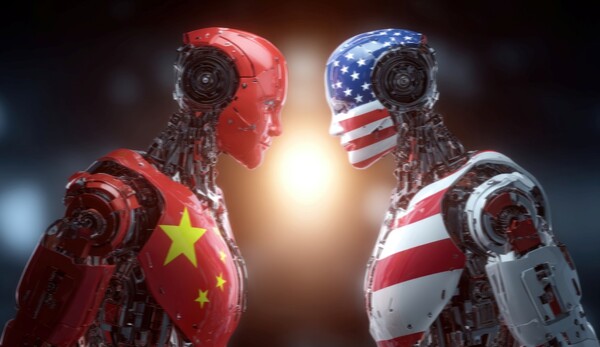
China is reported to have overtaken the United States this year in the size of venture investment in robotics.
Cryptopolitan, a blockchain media outlet, reported on Oct. 28 that China’s cumulative investment reached $13.2 billion, surpassing the United States’ $12.1 billion.
Global investment enthusiasm is also rising quickly. Global robotics venture investment totalled $9.9 billion in the third quarter, more than double $4.3 billion a year earlier. For the first three quarters, it rose about 185 percent from the same period a year earlier. Germany was far behind China and the United States, at $1.7 billion.
Large investments continued. In China, Guangzhou-based Xiaopeng Robotics raised $900 million and Shenzhen-based AI² Robotics secured a $736 million Series C round. In the United States, Atom, founded by Travis Kalanick, and Pittsburgh-based Skild AI drew large funding. Skild AI raised $1.4 billion to develop the "Skild Brain" model.
The number of unicorns is also rising steeply. Of about 75 robotics companies on Crunchbase’s unicorn list, many raised investment within the past three years, and 45 joined the list this year. Ulrik Stig Hansen, co-chief executive of data-layer company Encode, said physical AI is only now beginning to grow in earnest.
At the same time, warnings about overheating are emerging within China. Li Chao, a spokesperson for China’s National Development and Reform Commission, said in late November 2025 in Beijing that the number of humanoid robot makers in China had topped 150. He warned that an excessive increase in products that are almost identical to each other could crowd out research and development spending.
Investment flows have in fact shown signs of slowing. Investment in Chinese physical AI companies fell 40.1 percent in a month to 11.6 billion yuan in September from 19.4 billion yuan in August. Cumulative investment in the third quarter was 33.3 billion yuan, 28.7 percent lower than in the first half. Some state-backed investors have stopped reviewing new physical AI investments altogether.
Behind this is an unofficial warning issued in September by China’s securities authorities, known as “window guidance.” Humanoid robot startups seeking to list were required to show stable revenue, narrowing losses, or prove genuine innovation. Concerns also grew after the share price of Unitree Robotics, a leading Chinese humanoid company, fell by half from its peak after listing in Shanghai.
Even so, industry fundraising has not stopped. Agibot, seen as a key company in China’s robotics industry alongside Unitree, is seeking to raise 1.0 billion to 1.5 billion yuan at a valuation of about 50.0 billion yuan.
The United States, separately from the investment race, is speeding up steps to block Chinese-made robots. On June 3, U.S. Representatives John Moolenaar, Jay Obernolte and Jennifer McClellan introduced the GUARD Act. The bill would allow national security agencies to review humanoid and quadruped robots made by rival countries and ban imports if they are deemed a threat.
On July 28, the U.S. Federal Communications Commission (FCC) added foreign-made advanced robots to its covered list. Robots placed on the list cannot receive FCC approval without conditional authorisation from the U.S. Department of Defense. The House of Representatives separately passed a defense budget bill, and Article 163 of that bill barred the Defense Department from purchasing or operating humanoid systems made in China, Russia or Iran.
Market dominance is already tilting toward China. Chinese manufacturers accounted for 86 percent of about 22,000 humanoid units shipped worldwide in the first half of this year. With investment expansion and tighter regulation unfolding at the same time, the future robotics market is expected to develop into a structure in which China’s financial and supply advantages clash with U.S. security regulations.
 Jinju Hong
hongjj@d-today.co.kr