
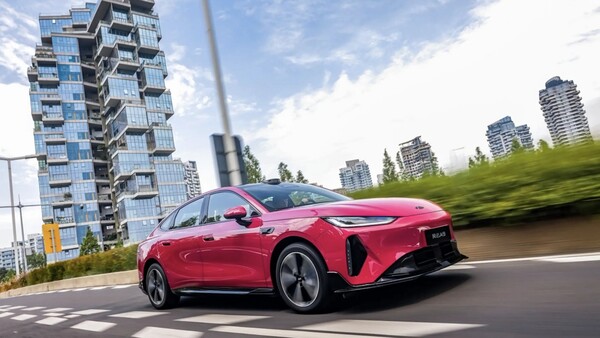
Chinese automaker Chery has unveiled an ultra-fast charging technology it says can deliver up to 500 km of driving range with a 5-minute charge. It also laid out a plan to build 20,000 charging stations worldwide capable of bidirectional charging by 2029.
According to InsideEVs, Chery unveiled its ultra-fast charging system, Volt-dragon, and vehicle-to-grid (V2G) technology at a global innovation conference held on Oct. 20 local time in Wuhu, Anhui province, China.
Chery said Volt-dragon can charge enough power in 5 minutes to drive about 500 km. Chinese local media reports said a room-temperature test took 6 minutes 50 seconds to charge a battery from 10 percent to 97 percent.
The charging equipment has a maximum output of 1.44 megawatts and a maximum current of 1,500 amperes. It has not been confirmed how much of that output an actual vehicle used. The vehicle used in the test, the battery capacity and the driving-range measurement standard were not disclosed.
Chery also highlighted charging convenience. It said it reduced the combined weight of the charging cable and connector to about 2 kg, and that operating noise is below 50 decibels. It is also pursuing a method in which a robotic arm automatically connects the charger to a vehicle.
The charging stations will combine solar power generation, energy storage systems and V2G technology. The method charges vehicles when electricity rates are low and supplies stored power to the grid when demand is high.
Chery aims to first build 100 charging stations in 10 cities in China and secure 20,000 V2G-supporting charging stations worldwide by 2029. It plans to apply V2G functions to the battery-electric Fulwin A9 in the first half of 2027.
Competition in ultra-fast charging is also intensifying in China. BYD announced a technology that secures 400 km of driving range with a 5-minute charge, and Geely Automobile unveiled a charging system with a maximum output of 2,250 kilowatts.
Chery did not disclose mass-produced vehicles that will support Volt-dragon's ultra-fast charging performance or a commercialisation timetable. Whether it can deliver the announced performance in real-world conditions is expected to determine its competitiveness.
 Jae-won Choi
ittt_0801@d-today.co.kr