
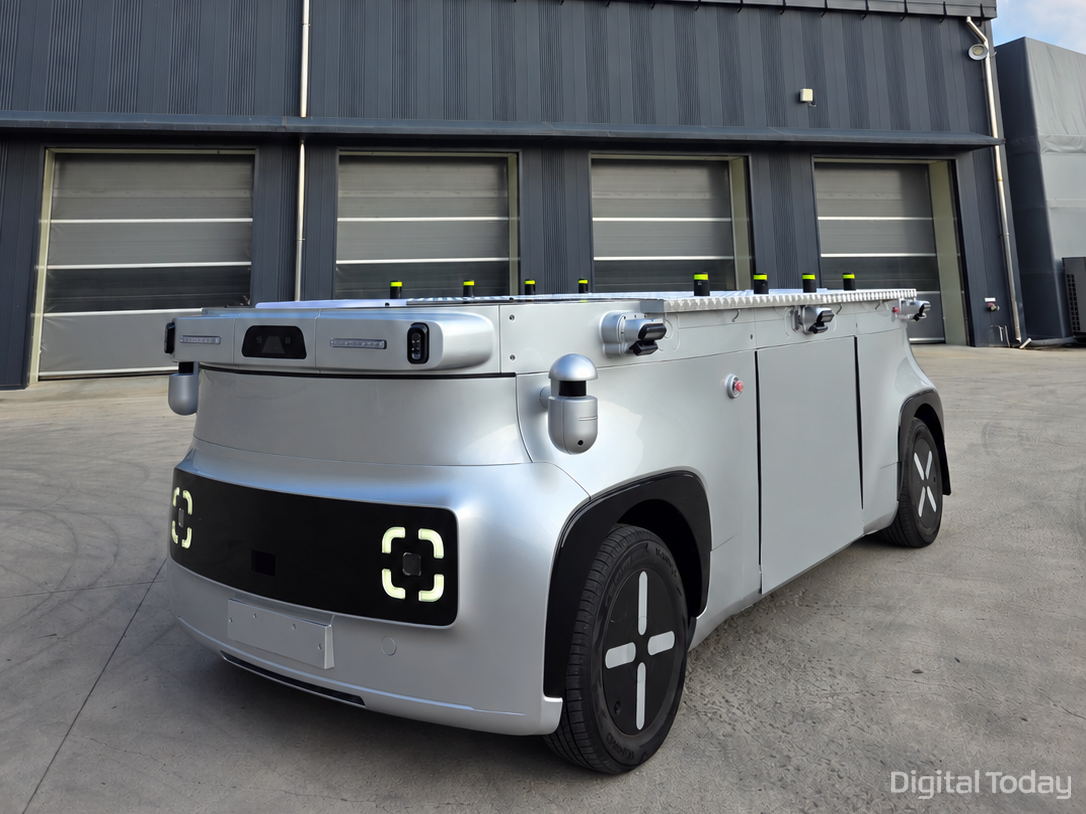
A prototype for an unmanned autonomous driving vehicle platform for logistics has been produced. Autonomous A2Z said on Oct. 29 it has completed a prototype logistics autonomous mobile robot based on its Level 4 autonomous vehicle ROii.
The prototype has a skateboard-type structure that carries cargo on a flat deck without a roof or enclosed cargo box. It is suitable for moving industrial parts of varying sizes and shapes, the company said. A2Z reinforced the vehicle body and loading section design to match loading for weights of 1 ton or more. It also added fastening hooks and protective guards to prevent cargo from shifting or falling while moving. Its sensors and their quantities, including cameras, lidar and radar, are the same as ROii's.
It also added safety functions for working environments. A combined safety lamp consisting of an autonomous driving indicator light, projection turn indicator light, safety line light and safety work light allows operators to check driving status and direction at night and in low-light indoor conditions. The controller and emergency braking and power switches were placed where workers can easily operate them from outside the vehicle and were fitted with a rain cover.
A2Z will also work with Chungbuk National University to advance autonomous driving technology suited to industrial sites. A2Z will develop a "situation understanding" model to respond to exceptional situations, while Chungbuk National University will develop an indoor and outdoor precision map inference model. The goal is to enable unmanned operation even at sites without precision maps. The prototype will be deployed at Gwangju Global Motors in 2027 for a demonstration transporting cargo from parts suppliers to an auto production plant.
A2Z Chief Executive Han Ji-hyung (한지형) said, "With the production of this unmanned autonomous driving platform for logistics, we have secured a foundation to connect autonomous driving technology accumulated in passenger transport with logistics demand at industrial sites." He added, "As demand for transport automation is growing at sites where freight transport is repeatedly carried out, such as manufacturing facilities and industrial complexes, we will verify feasibility through the GGM demonstration and move forward with commercialization."
 Dae-geon Seok
d2dg@d-today.co.kr