
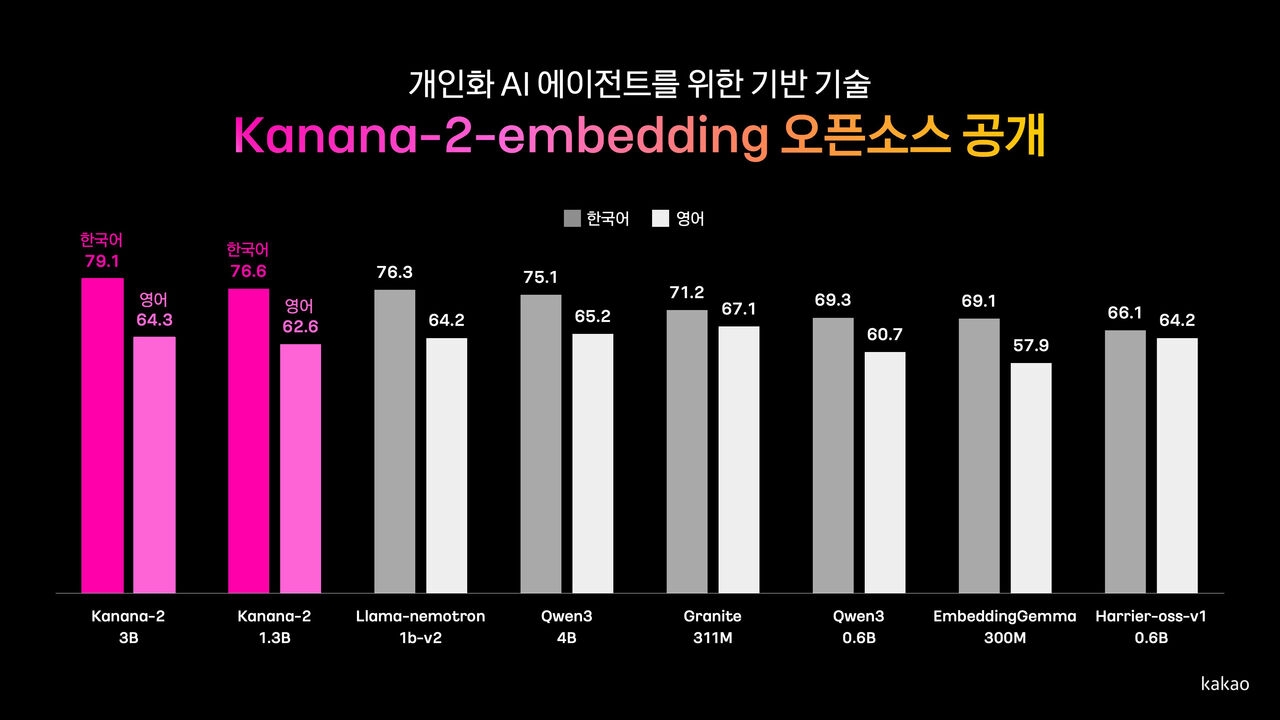
Kakao has open-sourced 2 embedding models that can be used for personalised AI agents and semantic search.
Kakao said on Oct. 29 it released the 3 billion-parameter Kanana-2-3b-Embedding and the 1.3 billion-parameter Kanana-2-1.3b-Embedding on Hugging Face.
Embedding models convert the meaning of text into numerical form to find information related to a query. They can search for semantically similar information even when exact words do not match. They are used for tasks such as retrieving past information for personalised AI agents and semantic search.
Kakao said it developed the 3B model by training it to use the language understanding capabilities of its in-house small language model, Kanana-2-SLM, for information retrieval. It later built the 1.3B model by applying knowledge distillation, a technique that transfers training information from a larger model to a smaller one.
Both models also apply MRL (Matryoshka Representation Learning), which allows the embedding vector size to be adjusted. Developers can choose a vector size depending on the service environment, taking into account search performance, storage space and processing speed.
Kakao said an internal evaluation comparing the released models with similarly sized Llama-Nemotron-Embed-1b-v2 and Qwen3-Embedding-4B found the models had the highest Korean-language performance and similar English performance. It also said they had higher inference efficiency than Qwen3-Embedding.
It said that, compared with the existing Kanana embedding model series, the new models improved search performance and also increased efficiency in memory use and inference speed.
The models use the Kanana Open License. Under the licence terms, commercial use is possible as well as research and development.
Kakao plans to continue research into embedding training and knowledge distillation using larger language models to improve search performance and operational efficiency.
Byeongseok Noh (노병석), performance leader for Kakao's Unified Foundation Model, said, "We will support researchers and developers so they can use embedding technology with strengths in Korean across a range of services, and we will continue research that improves both search performance and efficiency."
 Hojeong Lee
lhj@d-today.co.kr