
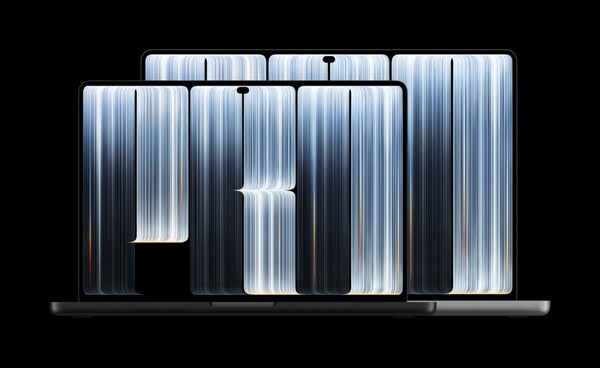
Apple unveiled a MacBook Pro with a touchscreen for the first time in the Mac lineup. It newly introduces touch controls and a tandem OLED display and applies the iPhone's Dynamic Island to Mac. It also enhances performance and portability for professional work.
Apple said on Oct. 28, local time, the new MacBook Pro will be released in two models: 14-inch and 16-inch. Pre-orders begin on Oct. 30 in Korea time, and the official release is Nov. 6.
The key features are touch controls and a new display. Apple applied its 'PROLED XDR Display' for the first time, based on tandem OLED technology that stacks two self-emissive pixel layers. It supports up to 2,000 nits of brightness for HDR and SDR content, with a contrast ratio of 10 million to 1. Refresh rate is variable from 10 to 120 Hz, and it supports both P3 and Adobe RGB color gamuts. For HDR video editing and color grading, it supports more than 80 percent of the Rec. 2020 color gamut. It uses an anti-reflective coating and offers an optional nano-texture finish to reduce reflections and glare.
Users can touch the screen to scroll, zoom photos, and move and arrange windows. In Pixelmator Pro, they can draw directly on the screen, and in Final Cut Pro they can manipulate video clips and edit ranges. In Logic Pro, they can play using on-screen keyboards and drum pads. The touch feature is designed to be used together with, not replace, keyboard shortcuts and trackpad controls. It also applies a hinge that reduces screen shake during touch use and an image-stabilisation feature for video calls.
Dynamic Island, introduced on the iPhone, is also being adopted on Mac for the first time. Users can check Spotlight search, live status, notifications and music playback information at the top of the display and use Siri AI.
Performance is powered by either the M5 Pro or M5 Max chip. Unified memory can be configured up to 128 GB, and SSD storage up to 16 TB. The M5 Max model can run large language models with hundreds of billions of parameters on-device. A neural accelerator built into the GPU cores and a third-generation ray tracing engine strengthen AI compute and 3D rendering performance.
The device weighs 1.38 kg for the 14-inch model and 1.82 kg for the 16-inch model. Battery life is up to 24 hours, and fast charging can charge up to 50 percent in 30 minutes. Ports include three Thunderbolt 5 ports, HDMI, an SDXC card slot, a MagSafe charging port and a headphone jack. It supports Wi-Fi 7 and Bluetooth 6. The M5 Pro model can connect up to 3 external displays, and the M5 Max model up to 4. It supports Touch ID but does not offer Face ID or built-in cellular connectivity.
The audio system has 6 speakers, using woofers with enhanced bass and tweeters that deliver clear sound. It also supports Dolby Atmos-based spatial audio and studio-grade microphones. The operating system is macOS 27 Golden Gate, providing Siri AI and Apple Intelligence features.
Prices start at 4.79 million won for the 14-inch model and 5.59 million won for the 16-inch model. M5 Max-equipped models start at 7.59 million won and 8.09 million won, respectively.
Apple uses 100 percent recycled aluminium for the enclosure and 100 percent recycled cobalt for the battery, with recycled materials making up 55 percent of the overall materials. It is part of a goal to achieve carbon neutrality across its products by 2030.
The product is also drawing attention as Apple changes its long-held stance on adding a touchscreen to its laptops. With Windows laptops that support touchscreens already widely available, Apple chose a direction of combining touch controls with existing input methods in professional work environments.
 Seung-a Yoo
ysah@d-today.co.kr