
[DigitalToday reporter Seulgi Son] Flitto is launching a new AI interpretation and translation service brand, Vogl (Voice of Global Languages·Vogl), and moving to expand its solutions business.
It is bundling interpretation, notes and meeting services for individual users into a single offering. In the corporate market, it is expanding event and in-store interpretation and translation and on-premise solutions. It is highlighting its personalisation technology built up through its AI training data business as a key competitive edge.
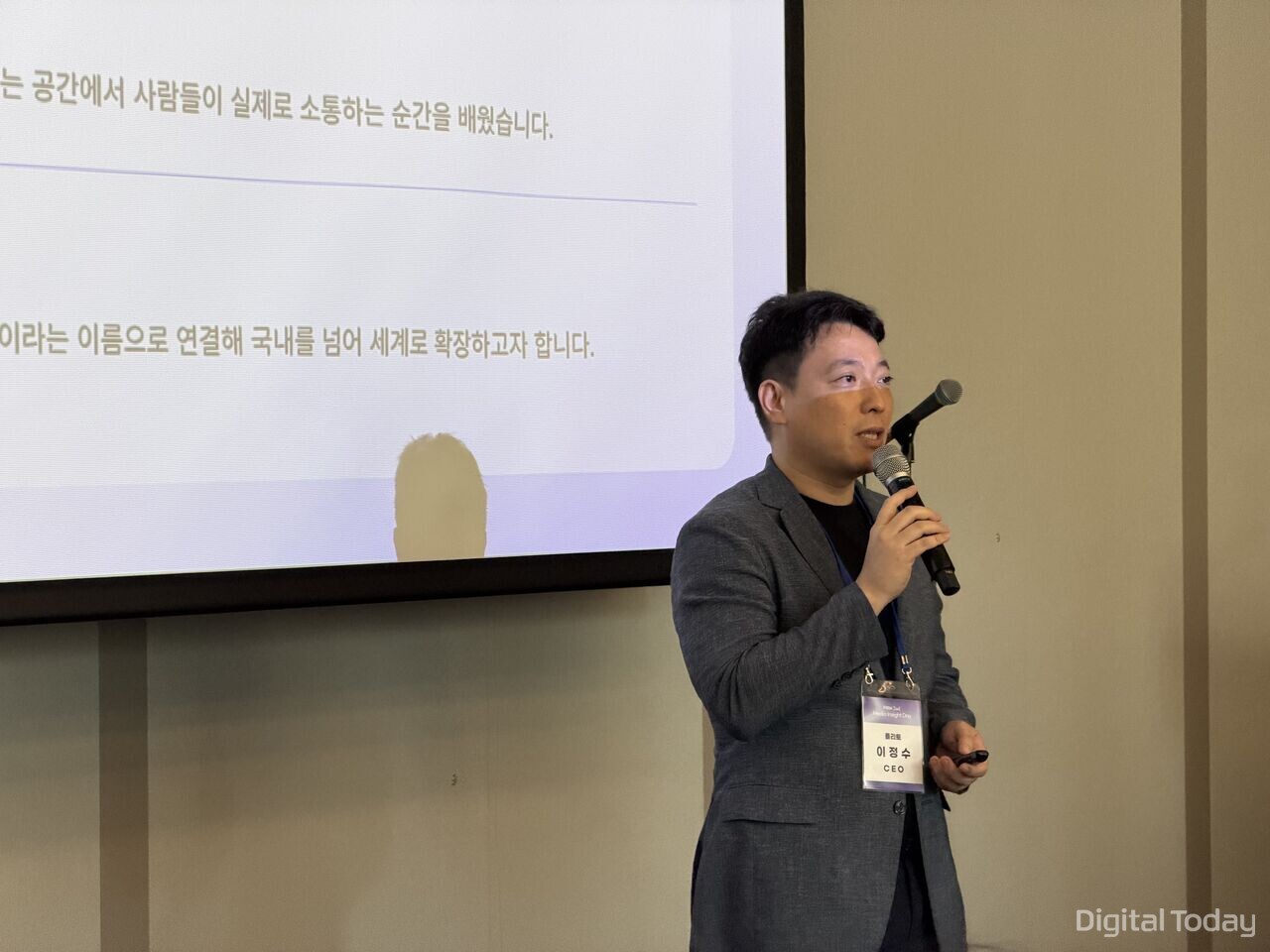
Flitto CEO Lee Jeong-su (이정수) said at the 'Flitto Media Insight Day' held on Sept. 30 at Grand InterContinental Seoul Parnas in Gangnam, Seoul, that the company integrated the solutions it had provided in a fragmented way into Vogl to create synergy. He said it will link each service around personalisation and expand them together.
He added that the solutions business is currently growing faster than the data business. He said the share of solutions in the overall business could rise from last year.
Vogl integrates Flitto's AI interpretation and translation services, which it has been developing since 2023, under a single brand.
In the B2C segment, it offers one-on-one conversational interpretation and translation, along with note and meeting functions. Notes provide real-time recording and summarisation and search for conversations or interviews, and analyse conversational context to suggest the next question. The meeting function is web-based and supports real-time interpretation and translation even when users speak different languages.
Vogl's core technology is its personalisation engine. The more a user uses the service, the more it learns pronunciation, proper nouns, frequently used expressions and industry-specific terminology to improve speech recognition and translation accuracy. Personalisation data created once is designed to be linked not only to conversation and notes but also to other Vogl services.
Lee said that how well the service understands an individual matters in interpretation. He said personalisation is what Flitto has developed through its long-running data business, and that Vogl's competitiveness ultimately comes from data.
In the enterprise segment, it offers real-time interpretation and translation for events and conferences under 'Vogl Stage', 'Vogl Zone' installed at hotels and stores, an application programming interface (API) and on-premise solutions for corporate users. Flitto's interpretation and translation technology is also applied to Cisco Webex.
Flitto is expanding its on-premise business, particularly for companies with high security requirements. It builds interpretation and translation models on customers' internal servers so that voice and text data generated during meetings or work processes do not leave for external clouds. It is increasing supply to major domestic companies and institutions and plans to expand to global markets.
Lee said the on-premise solution is expanding rapidly. He said the company plans to bring a framework for building interpretation models while maintaining security to global markets.
It is also expanding its business scope beyond software into hardware. Flitto is conducting research and development on dedicated devices that can provide stable AI interpretation and translation in real-use environments such as university lecture rooms. It aims to address the limitation that using recording or interpretation services on smartphones can conflict with other functions such as calls and taking photos.
Lee said the device area is one it has been considering for more than 2 years. He said it will be able to introduce various devices under the Vogl name in 2027. It is also reviewing ways to link Vogl with external devices such as smart glasses and earphones.
Flitto is also expanding its AI training data business, which underpins its solutions competitiveness. It started with text and has broadened its data-building scope to voice, images and video, and recently expanded into training data for physical AI.
In physical AI, it collects egocentric videos shot from a first-person perspective of a worker's everyday actions through crowdsourcing. It then filters out defective footage and extracts hand movements and position and angles to process it into data for pretraining vision-language-action (VLA) models. Rather than directly building large volumes of sensor data for each robot, it is focusing first on securing human behavior data across diverse environments for use in basic robot action learning.
It also operates a data marketplace where AI training data can be bought and sold. More than 500 datasets are currently registered, and 300 to 400 that have undergone reviews for copyright, personal information and ownership are 공개돼 있다. Actual transactions are also taking place, and it plans to grow a fee business tied to transactions of external sellers' data.
Meanwhile, Flitto posted consolidated revenue of 13.3 billion won and operating profit of 1.3 billion won in the first half of this year. In the second quarter, it recorded revenue of 8.1 billion won and operating profit of 1.4 billion won, turning profitable from an operating loss in the first quarter. First-half revenue from AI interpretation and translation solutions in particular rose 175 percent from a year earlier to 2.43 billion won.
Lee said revenue is currently higher than expected and net profit is also higher than expected. He projected both revenue and profit this year will improve from last year as revenue recognition for the data business is concentrated in the second half.
 Seulgi Son
sageson@d-today.co.kr
Seulgi Son
sageson@d-today.co.kr