
[DigitalToday reporter Jin-ho Lee (이진호)] The government will invest about 4 trillion won next year in seven future growth engines: small modular reactors (SMRs), nuclear fusion, renewable energy, quantum, aerospace, advanced bio and advanced supply chains. It also plans to invest more than 200 trillion won in national research and development (R&D) over the next five years and to push ahead in earnest with “K-Moonshot,” which uses AI to solve hard science and technology challenges.
The Ministry of Science and ICT said Deputy Prime Minister Kyung-hoon Bae (배경훈), who also serves as science minister, chaired the 13th meeting of ministers for science and technology-related affairs at the Government Complex Seoul on Tuesday and discussed five agenda items including a plan to 추진 the “Future Growth Engine Seven SEED Project.”
The meeting covered the plan to 추진 the seven SEED projects, steps to support R&D-IP-commercialisation innovation based on intellectual property (IP), measures to strengthen the innovation base to 추진 irreplaceable R&D, and the K-Moonshot strategic roadmap.
◆ 4 trillion won for seven SEEDs next year... all-government, public-private 추진 system to be launched
The government selected SMRs, nuclear fusion, renewable energy, quantum, aerospace, advanced bio and advanced supply chains in August as the seven SEEDs for future growth engines. This time, 15 ministries, agencies, offices and commissions participated to detail the 추진 system, fiscal investment and support measures for startups and commercialisation.
It will invest about 4 trillion won in the seven SEEDs in 2027. It will expand investment-type R&D in which the government and companies co-invest to share risks, and also use the future response fund’s growth engine account. Existing R&D programmes will be reorganised to match the objectives of the SEED projects.
It will operate a joint 추진 system across ministries and with the private sector centred on the meeting of ministers for science and technology-related affairs. The lead ministry for each field will form a consultative body involving the government, research community and industry to draw up specific targets and an implementation strategy by the end of this year.
It will also strengthen support for commercialisation and startups. It will 추진 deep-tech startup strategies tailored to the characteristics of each SEED and support corporate growth through the National Growth Fund, the Science and Technology Innovation Fund, and the fund of funds. It will also pursue localisation of advanced research equipment and regulatory rationalisation in parallel. In areas where regulations and standards are not sufficiently in place, such as quantum and aerospace, it will move to secure international standards first. It plans to establish regulatory systems that reflect the characteristics of each technology for SMRs, nuclear fusion and renewable energy.
◆ More than 200 trillion won to be invested in national R&D over five years... overhaul of evaluation, universities and commercialisation systems
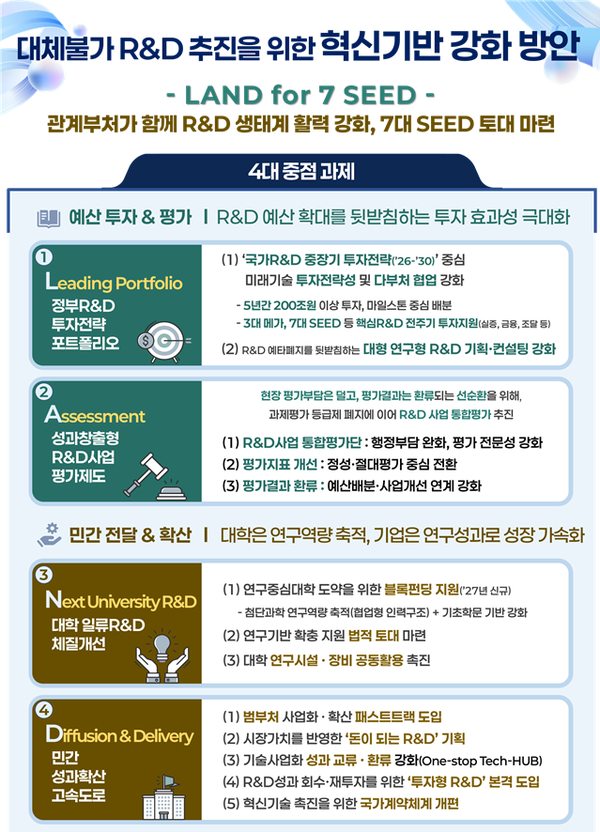
The government will also revise how national R&D is invested and evaluated. Under the “National R&D Mid- to Long-Term Investment Strategy,” it will invest more than 200 trillion won over the five years from 2026 to 2030. In key areas such as the seven SEEDs, it will link demonstration and commercialisation from the early stages of investment and expand inter-ministerial cooperation in project planning, budget allocation and implementation.
For large R&D projects of 100 billion won or more, it will strengthen checks on advance planning. It will shift from the current system split between ministry self-evaluations and higher-level evaluations by the Office of Science and Technology Innovation to an integrated project evaluation. It will change evaluation indicators to a qualitative, absolute evaluation focused on headline results and subdivide evaluation outcomes into five grades. Results will be used for budget allocation, project improvements and follow-up checks on implementation.
To help universities build research capabilities at the institutional level, it will introduce a new institution-support “block funding” programme for research-focused universities. It will expand research support staff such as full-time researchers and equipment support personnel, and also broaden shared use and opening of university research equipment.
It will also strengthen the commercialisation system to spread research results to the private sector. It will set up an all-government consultative body on technology commercialisation and link transfers and tracking management of research outcomes with securing buyers and with guarantees and funds. It will also expand competitive, phased evaluation R&D that takes commercialisation potential into account and expand support packages for demonstration and certification.
It will link IP strategy to the full national R&D process. It will analyse global patent trends and promising technologies in national strategic technologies and reflect them in R&D roadmaps, and it will build a national patent strategy map starting with physical AI. Patent information will be made into AI training data and used for R&D.
It will support securing overseas foundational patents for top public technologies and also 추진 securing standard-essential patents in future industries such as AI and robotics. It will standardise management criteria for technology licensing offices (TLOs) at universities and public research institutions and support training IP-dedicated personnel.
◆ Solving scientific challenges with AI... K-Moonshot to be pushed in earnest
The government also detailed a strategic roadmap for K-Moonshot, which combines AI and science and technology to speed up solutions to difficult challenges. It identified technological challenges to be solved in the seven SEEDs and three mega projects and presented R&D and demonstration plans and step-by-step targets for the next 10 years.
To support this, it will build an inter-agency GPU network centred on the country’s sixth supercomputer with about 8,000 GPUs and secure dedicated computing resources needed for K-Moonshot missions. It will automatically convert experimental data from government-funded research institutes into forms that AI can use and support the development of mission-specific AI agents.
It also set out targets by field. In nuclear fusion, it will build an AI virtual fusion reactor platform in 2029 and use it to cut the design period for an innovative fusion reactor by 50 percent by 2032.
In SMRs, it will develop an AI-based general-purpose virtual reactor in 2029 and build a platform for the development and verification of ship-specialised SMRs by 2032. For physical AI, it aims to secure technology applicable to constrained environments and repetitive tasks in 2027 and then secure world-top-level general-purpose physical AI in 2029.
In new drug development, it will develop a bio AI model dealing with areas such as the cancer immune microenvironment in 2028 and 추진 building an AI autonomous laboratory for new drug development in 2029.
Deputy Prime Minister Bae said, “As various opinions have recently emerged that the pace of AI development should be adjusted, discussions on international cooperation to respond to advanced AI risks are active.” He said, “The path South Korea must take is to become an AI nation that can go faster while also going safer.”
He added, “We must pursue AI R&D and its use in industry and everyday life more actively, and we must also put in place sturdier safety devices against risks that AI can bring.” He said, “We will continue to enhance policy execution through coordination and cooperation among ministries on major pending issues.”
 Jin-ho Lee
jhlee26@d-today.co.kr
Jin-ho Lee
jhlee26@d-today.co.kr