
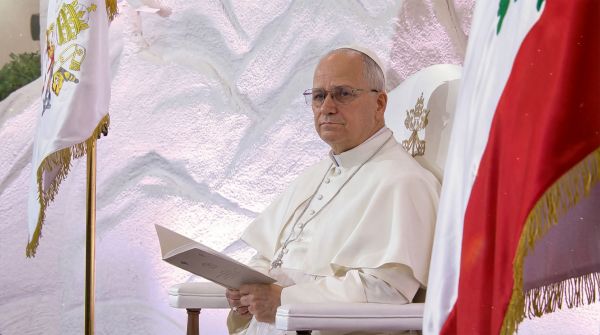
Pope Leo XIV publicly criticised U.S. President Donald Trump and Nvidia CEO Jensen Huang for downplaying the risks of artificial intelligence (AI).
Cryptopolitan, a blockchain media outlet, reported on Monday that the pope said an attitude that turns a blind eye to threats posed by technology endangers humanity's shared future. He said human safety should be treated with greater weight.
The remarks came after Huang opposed earlier this month the introduction of new regulations to address AI's potential risks. Huang said at the time, "We don't need new laws. We don't need new regulations," arguing that development speed and safety are not a matter of choosing one or the other. He said rapid technological progress and strong security can go together.
Nvidia recently unveiled new AI safety tools, including a monitoring system called Sentry. The pope said he had seen the launch itself, but said it was questionable whether Huang's opposition to federal-level oversight shows real commitment to safety. The pope criticised Huang as "the same person" who said there should be no limits and no government regulation.
The pope has defined AI as a major threat to humanity since early in his papacy. In May, he issued a new encyclical with Anthropic co-founder Christopher Olah, urging the tech industry to consider responsibilities beyond profit. On Monday, the pope also stressed that political leaders, the AI industry and civic groups should together examine what is happening now and risks that could lie ahead. He said closing one's eyes by saying "it will not happen" is not a responsible approach.
This awareness also overlaps with warnings from executives at major AI companies. At a recent U.N. Security Council forum, Anthropic's Dario Amodei and OpenAI's Sam Altman warned of the risks of uncontrolled AI and urged cooperation to build regulatory frameworks even among rival countries. Amodei earlier released a piece arguing that the pace of AI development should be adjusted.
Huang has not denied safety issues themselves. Introducing Nvidia's latest open-source safety system, he said AI's social potential can be realised only when AI safety issues are solved. He did not say he would slow development. Differences in views among politicians, companies and the public sector over the need for regulation have become clearer.
Public opinion is also split. Stanford University data showed 52 percent of respondents said they feel anxiety about AI technology. The share saying AI's benefits outweigh its downsides rose to 59 percent in 2025 from 55 percent in 2024. That means expectations for technology are growing while awareness of risks remains high.
By region, more than 80 percent of respondents in Malaysia, Thailand, Indonesia and Singapore predicted that AI will significantly change their lives within 3 to 5 years. Among them, Malaysia saw the largest shift in perceptions compared with 2024.
Anxiety in the labour market also continued. In an Ipsos tracking survey, a majority of workers throughout 2024 and 2025 worried that AI could disrupt their role or make it disappear within the next 5 years. The concern was particularly high in the United States and Canada. In the two countries, 67 percent and 68 percent of respondents, respectively, said AI could eliminate jobs and make the broader industry unstable.
Trust in how much governments can control AI showed wide variation by country. Stanford University's 2026 AI Index noted that public anxiety does not translate into trust in existing oversight systems. As AI development accelerates, debate is expected to grow over how strong oversight should be and who should be responsible for it.
 Jinju Hong
hongjj@d-today.co.kr
Jinju Hong
hongjj@d-today.co.kr