
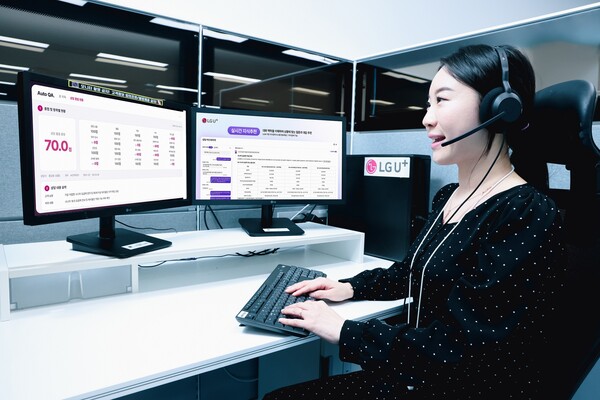
When a customer asks about a low-cost plan for seniors, senior plan information and an answer guide appear on the counselor’s monitor in real time. When questions follow on possible additional discounts and text and data allowances, AI presents the relevant policies in sequence. The counselor explains what the customer needs based on the information the AI finds.
AI support has improved efficiency by taking on work in which counselors used to search for and organize information themselves. The average consultation time at LG Uplus customer centers has fallen 16 percent from 2024, and wait time to connect to a counselor has been cut to 5 seconds from 47 seconds.
Based on its in-house customer center operating experience, LG Uplus is moving to build an "AI native contact center" that eliminates consultation wait times by 2030. It aims to first apply AI technology to its own customer centers to verify performance and customer response, then provide it as a business-to-business solution through its "insourcing AICC" offering. The goal is to grow AICC business revenue by more than 50 percent a year on average by 2030.
LG Uplus held a press briefing on Tuesday at the LG Gasan Digital Center in Seoul’s Geumcheon district and disclosed its AICC strategy and results from applying it to customer centers. Key solutions were demonstrated on site, including AI callbots and chatbots, an "AI consultation advisor" and an "AI Auto QA" technology that automates consultation quality assessment.
Companies have recently been expanding adoption of AICC to improve consultation efficiency and customer experience. Still, the rapid pace of AI development creates concerns that solutions built at large cost could lose competitiveness in a short period. Existing AICC systems also had limits because they rely on fixed scenarios and do not sufficiently reflect the context or intent of customer questions.
LG Uplus has used its own customer centers as the starting point for technology verification to address this. With tens of millions of consultations conducted annually across 17 customer centers nationwide, it said it can check AI performance and stability based on responses from customers and counselors.
Functions that complete verification are supplied to outside companies as B2B solutions. Specialized personnel with customer center operating experience visit client sites to provide consulting tailored to work characteristics, and requirements raised in the field after adoption are reflected back in solution improvements.
AI is also used in the AICC building process itself. LG Uplus uses EXAONE from LG AI Research and AI models from global big tech companies. When a customer inputs the desired consultation purpose and work guidelines, AI automatically generates consultation scenarios, work procedures and consultation agents.
It then verifies consultation quality in advance through simulations similar to the actual operating environment. After service adoption, AI analyzes accumulated consultation data again to find problems and suggest improvements.
During actual customer consultations, multiple AI solutions are used depending on the nature of the work. Inquiries that can be handled without connecting to a counselor, such as fee lookups or service sign-ups, are handled by AI callbots and chatbots. At LG Uplus, about 8 million customer inquiries a year are currently handled through AI callbots and chatbots.
The AI callbot goes beyond recognizing specific words to identify customer intent based on the context of the entire conversation. It focuses on providing an experience similar to talking with a person, such as waiting until an utterance finishes even if the customer pauses mid-sentence and guiding the customer through processing status.
After a customer is connected to a counselor, an "AI consultation advisor" supports the session. It converts the conversation between the customer and the counselor into text in real time, analyzes the context and presents needed product information, policies and answer guides on the counselor’s screen.
Counselors can reduce time spent moving through internal systems to find information and focus on understanding the customer’s situation, emotions and additional needs. It can also reduce quality variation stemming from differences in counselor experience, as less-experienced counselors can quickly check needed answers based on information provided by the AI.
After a consultation ends, "AI Auto QA" analyzes consultation quality. AI analyzes consultation content and presents strengths and areas for improvement by counselor. Previously, consultation coaches had to listen to recordings and evaluate some consultations, but using AI allows more consultations to be analyzed under the same standards. Consultation coaches can focus on analyzing each counselor’s characteristics and improvement tasks and on customized coaching instead of repetitive monitoring.
LG Uplus said that after applying these AICC technologies to its own customer centers, average wait time to connect to a counselor fell about 90 percent to 5 seconds this year from 47 seconds in 2024. Average consultation time also fell 16 percent over the same period.
Consultation capacity freed up by AI adoption will be used to strengthen customized services by customer. Counselors will respond first to elderly customers aged 65 and older, and hearing-impaired customers will be connected to sign language counselors. Customers who do not want AI consultations can choose the existing consultation method.
LG Uplus plans to further advance AICC into an "AI native contact center" in which the entire customer response process is run around AI. Before a customer requests a consultation, AI analyzes past consultation history and subscription information to identify customer intent and first presents the information needed.
Its ultimate goal is to implement "consultations without waiting" that eliminate time spent waiting to be connected to a counselor. At the same time, it will build an AICC system that improves itself by analyzing consultation data generated at customer centers in real time and reflecting improvements back into services.
Hyung-kyun Ahn (안형균), executive director and head of the Enterprise AI Business Group at LG Uplus, said, "Based on the experience accumulated through operating our own customer centers and our insourcing competitiveness, we will support corporate customers’ AI transformation and foster the AICC business as a core growth axis of the enterprise AX business by 2030."
 Jin-ho Lee
jhlee26@d-today.co.kr
Jin-ho Lee
jhlee26@d-today.co.kr