
SK Telecom is accelerating upgrades to its proprietary foundation model. It aims to combine specialised knowledge from industrial sites such as manufacturing, semiconductors and batteries with its model, expand it into "working AI" and protect technological sovereignty.
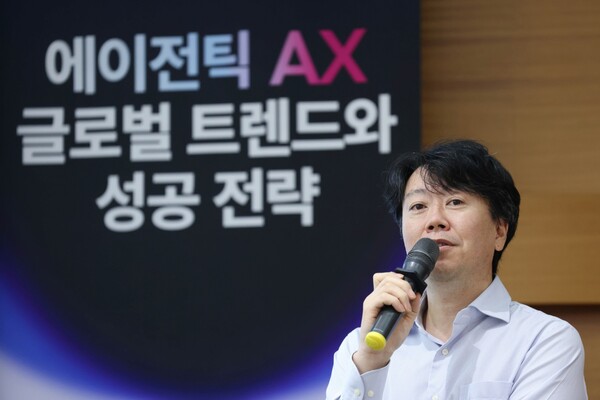
Kim Tae-yoon (김태윤), SKT vice president in charge of foundation models, said at the "Digital Insight 2026" conference held at COEX in Seoul on Sept. 29, "When it comes to turning subtle knowledge from industrial sites into assets, domestically developed models or models we can control have a huge advantage."
Kim said the current trend in AI models is rapidly shifting toward agent-based working AI. He forecast that AI technology will move beyond simple question-and-answer and code-writing and, after 2027, develop into multi-agent systems in which multiple AIs divide roles to carry out tasks.
The performance of AI agents depends on foundation models. SKT's foundation model undergoes pretraining that learns knowledge from large-scale data, then improves real-world work capability through supervised fine-tuning (SFT) and reinforcement learning (RL). In the supervised fine-tuning stage it learns correct answers and ways of acting, and in the reinforcement learning stage it improves judgement and behaviour by reflecting rewards and penalties based on work results.
In particular, in the era of agentic AI it is important that results from performing tasks in real environments feed back into learning. He said that if existing large language models (LLMs) focused on generating text, foundation models in the agentic AI era evolve toward directly judging and acting in digital environments.
Kim stressed the importance of capabilities to choose core AI technologies directly and continually improve them to fit industrial characteristics. SKT is developing a family of models centred on A.X K2, covering reasoning and agents as well as vision and voice functions. The government's independent AI foundation model project has entered its third development stage. In the second-stage evaluation it delivered performance at a level that earned a gold medal in solving International Mathematical Olympiad problems.
SKT is focusing on accumulating specialised industrial-site knowledge in its proprietary model. It has concluded that a homegrown AI that understands the characteristics of Korean industry is needed to sufficiently reflect data generated in the field and work context. Kim said, "As we have been building a foundation model for the past three years, what we heard most often was 'why build it yourself,'" and added, "The biggest reason is for Korea to have the choice over key technologies in the AI era."
He also stressed, "Not only cultural sovereignty contained in speech and writing, but knowledge of traditional industries such as semiconductors and batteries must be put into the model," and "Since it is not easy to put all knowledge into external models, the capability to develop proprietary models that we can improve ourselves is important."
SKT, however, avoids an absolute performance contest. Kim said, "What matters is not saying from the start that we will make an unconditionally smart model, but making a model that can actually be used," and added, "Going forward, various models will exist in various forms."
He cited "evaluation" as the most important task in developing agentic AI. Because agents make their own judgements and act across multiple steps, it is difficult to measure performance solely by whether there is a single correct answer, as in the past. Proprietary models also have advantages in terms of safety and control. Kim said, "I can certainly tell you it is safe. Models made domestically can be built and controlled directly."
SKT plans to build a structure linking AI data centres, its proprietary foundation model and AI services so that on-site evaluation and feedback again raise model performance. It is a strategy to create a virtuous cycle linking model-agent-service-data by using data obtained from real services, including the independent AI foundation model project and "AI for Everyone," to improve the model.
Kim said, "The virtuous cycle in which accumulated feedback feeds back into reinforcement learning and post-training is the source of competitiveness," and added, "The true competitiveness of domestic models is created at the point where the model, agent, service and data are connected."
 Jin-ho Lee
jhlee26@d-today.co.kr
Jin-ho Lee
jhlee26@d-today.co.kr