
OpenAI has unveiled a three-step business strategy centred on providing top-performing artificial intelligence (AI) models, expanding build tools for developers and building a market that connects corporate customers with partners.
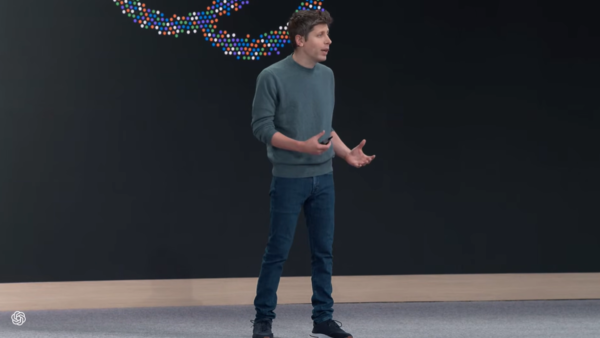
On Sept. 29, Sam Altman (샘 알트먼), OpenAI's chief executive, laid out the company's long-term business plan at its developer event DevDay in San Francisco.
Altman set out a strategy that runs from model to build to distribution. OpenAI will first provide competitive AI models at a range of price points. It will then expand tools so developers can create the services they want. It also plans to develop OpenAI into a kind of "market" that connects corporate customers with partner products.
"We want to give you the same tools that we use," Altman said. "We want to support you with a powerful platform where you can build anything," he said.
For the first stage, model competition, OpenAI unveiled "GPT-6.1 Sol" on the day. GPT-6.1 Sol offers a similar level of performance to its latest model, GPT-6 Astra, at a lower cost. OpenAI also introduced "Ultrafast", which allows faster access to the model in exchange for higher payment. OpenAI set out a goal of offering an optimal combination of intelligence and performance at every price point.
OpenAI's emphasis on both performance and price reflects intensifying competition. OpenAI, which started as a research organisation, is now competing in AI models with Anthropic, Meta, Google and SpaceXAI, while Chinese companies are also competing with low-cost models. OpenAI is still investing a significant share of its computing resources in research, and competition to secure both performance and price is continuing.
The second stage is build. OpenAI is expanding the development environment so developers can use the same tools it uses internally to create AI services. It expanded the Codex AI coding tool into the cloud so it can be used across multiple devices, and it provides an API for developers to build AI agents. It also unveiled a new API to support faster decision-making.
OpenAI aims to let developers build AI services within a single ecosystem without using multiple services separately. It already provides an agent API based on Codex that can build long-running agents.
The third stage is distribution. OpenAI plans to expand its role to connecting corporate customers and partners, based on more than 1.2 billion weekly ChatGPT users. Corporate customers will be able to use part of their existing OpenAI usage commitments to purchase partner products. Other AI products will let users use part of their token allocation through a "Log in with ChatGPT" function.
That means OpenAI does not intend to stop at supplying AI models, but also to act as an intermediary that links demand among companies and customers within its own ecosystem. In a post-event question-and-answer session, Altman cited cloud computing companies as a reference case for expanding the ecosystem and said he wants OpenAI to become a place that connects demand and links customers.
"I want to put this everywhere and get people, revenue and customers moving, and build as strong and rich an ecosystem as possible," Altman said.
The strategy is seen as spelling out OpenAI's plan to expand from an AI model developer to an ecosystem operator that links a development platform and business-to-business transactions. OpenAI plans to secure model competitiveness, provide an environment in which developers can build services, and build a structure that connects its large user base to corporate customers and partner products.
 Seung-a Yoo
ysah@d-today.co.kr
Seung-a Yoo
ysah@d-today.co.kr