
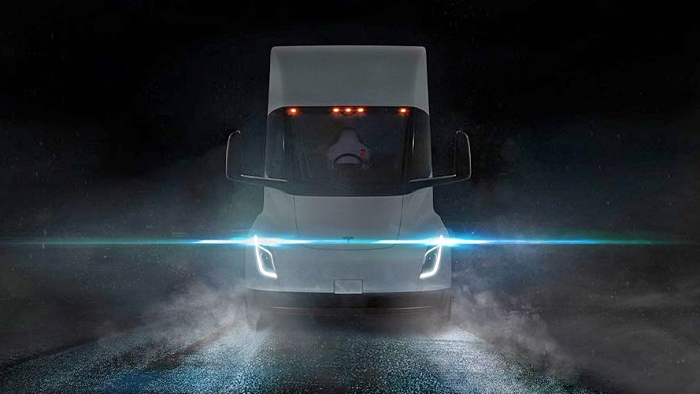
Tesla has opened its first dedicated plant to mass-produce its Semi heavy-duty electric truck in Sparks, Nevada. Chief Executive Elon Musk is seeking production capacity as the company expands beyond passenger EVs into the heavy commercial vehicle market.
Tesla recently held an opening event for the Semi plant in Sparks, Nevada. It set the plant’s annual production capacity at up to 50,000 units. The Semi was first produced on the plant’s high-speed line in April, and the opening marked the official start of dedicated production. Tesla is also stepping up its push into the commercial vehicle market by securing large orders in succession.
At the same time, expectations and reality are diverging around Tesla’s self-driving technology. The in-car AI mentioned the possibility of unsupervised driving in the next-generation FSD V15, while the timetable for FSD approval across Europe has been delayed again, raising interest in the pace of commercialisation.
• Tesla to make 50,000 trucks...Semi mass-production plant finally starts up • Tesla becomes main supplier for the largest U.S. order ever for electric Class 8 trucks...2,500 units • Tesla in-car AI ‘Ara’ mentions FSD V15, could it enable unsupervised driving? • Tesla FSD approval across Europe delayed again...EU vote postponed to December from October
The share of Tesla vehicles deemed total losses despite short operating periods appears higher than other electric cars, raising concerns over repair costs and residual values.
• “It’s only been 5 years”...Share of Teslas with total-loss history is 19 percent, gap with other EVs
Mercedes is accelerating competition in future vehicles by highlighting an AI-based autonomous driving system and next-generation all-solid-state batteries. It plans to apply Weave’s AI driving system to vehicles within 2 years and has secured ProLogium’s fourth-generation all-solid-state batteries, as it seeks to strengthen competitiveness in both self-driving and battery technology.
• Mercedes to install Weave AI driving system within 2 years...“Catch Tesla FSD” • Mercedes moves to secure ProLogium fourth-generation all-solid-state batteries...“All-solid-state by 2030”
Hyundai Motor is also accelerating development of all-solid-state batteries, which are seen as the next-generation battery for the EV market. It is placing more weight on securing technological competitiveness than immediate commercialisation and is continuing a long-term strategy aimed at an all-solid-state era in 5 years.
• “We can’t give up on all-solid-state batteries now”...What Hyundai Motor is targeting in 5 years
South Korea’s mobility industry is moving to expand in global markets and secure competitiveness in materials for future vehicles.
LG Chem has joined hands with a global automaker to target the automotive materials market. LG Chem said it signed a memorandum of understanding with Volkswagen Group to develop next-generation and eco-friendly mobility materials and expand their application. The two companies will use LG Chem’s high value-added ABS synthetic resin and its engineering plastic EP to pursue vehicle lightweighting and improved performance. They will also jointly develop next-generation plastics and composite materials.
Kakao has put the brakes on a plan to pursue a U.S. American depositary receipt listing for Kakao Mobility. It judged that the listing plan under review is focused on liquidity for existing stakes held by TPG, the second-largest shareholder, and is difficult to see as being returned as an economic benefit to Kakao’s common shareholders.
• LG Chem teams up with Volkswagen on future-car materials, led by ABS and EP • Kakao blocks Kakao Mobility U.S. listing...Opposes TPG stake-liquidity structure
China’s mobility industry is targeting both safety and convenience in transportation by tightening drone regulations and developing ultra-fast charging technology.
Beijing recently revised the ‘Beijing municipal regulations on the management of unmanned aircraft’. The new rules ban possessing or storing unmanned aircraft and key parts across Beijing and also restrict transporting or bringing them in from outside. As a result, residents must dispose of drones they own or move them outside Beijing by the effective date of Nov. 15.
Geely Group, meanwhile, unveiled next-generation charging technology with output of up to 2.2 megawatts. Geely claimed the technology can charge an EV battery in about 4 minutes. The technology is expected to be first applied to the electric premium SUV ‘Galaxy E5’, set for launch in China this year.
• Beyond flight bans to ownership bans...Beijing sharply tightens drone rules • Geely unveils 2.2MW ultra-fast charging technology...Charging finished in 4 minutes?
Audi’s A6 Sportback e-tron Performance drove 1,338 km on a single charge, setting a Guinness World Records mark for the longest distance by an EV on a single charge.
Rally driver Miko Marczyk (미코 마르치크) began the record drive in Poland at 1:55 a.m. on the 11th in an Audi A6 Sportback e-tron Performance. He travelled along the Vistula River through Krakow, Sandomierz, Warsaw, Torun and Grudziadz to Hel on the Baltic coast, then returned along the same route.
• Audi A6 e-tron drives 1,338 km on one charge...Sets new Guinness world record
 Jinju Hong
hongjj@d-today.co.kr
Jinju Hong
hongjj@d-today.co.kr