
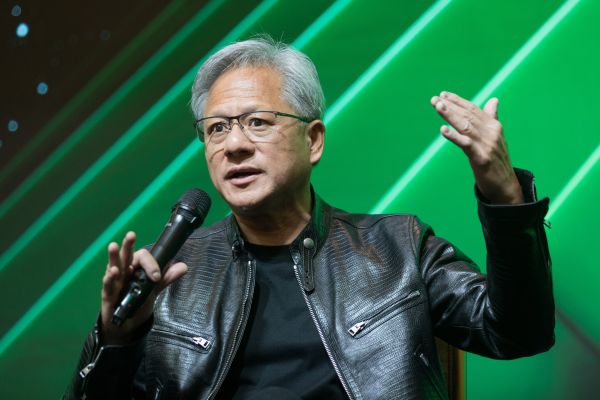
[Digital Today intern reporter Seung-a Yoo] Nvidia CEO Jensen Huang (젠슨 황) called the "distillation" technique of training a new artificial intelligence (AI) model based on the output of another AI model "competition". It differs from the U.S. government’s view that extracting the capabilities of U.S. AI models through distillation is "theft."
On Sept. 28, CNBC reported that Huang made the comments as distillation emerged as a key issue in the U.S.-China rivalry for AI leadership.
AI model distillation trains a relatively lower-performing model using the output of a more powerful model. U.S. authorities have pointed to Chinese AI companies using this method to obtain capabilities from AI models developed in the United States. U.S. Treasury Secretary Scott Bessent (스콧 베선트) in July described distillation as theft and warned sanctions could be imposed on foreign companies that extract capabilities from models developed in the United States.
Huang, however, viewed distillation as part of competition. In a CNBC interview, he answered "That’s what you call competition" when asked whether distillation was "robbery."
He then said companies can test other people’s products as much as they want. He added that Nvidia products are also analysed "to the bone" so companies can figure out how they work.
Huang said Nvidia also does not want rivals to use its products for training. He said, "I wish they wouldn’t," but added, "Competition makes everything better."
He also added, "If you don’t like someone using your product, then understand your customers and stop servicing them." He suggested providers can manage users and restrict access rather than defining distillation itself as illegal.
The U.S. government has maintained a hard line on distillation. The Cybersecurity and Infrastructure Security Agency (CISA), part of the Department of Homeland Security, warned earlier this month with the National Security Agency (NSA) and the Federal Bureau of Investigation (FBI) that Chinese-linked AI companies were running an industry-scale knowledge distillation campaign to extract proprietary functions and capabilities from models of U.S. AI companies. The agencies named DeepSeek, Moonshot AI, Alibaba, Minimax, StepFun and Z.AI.
CISA said distillation itself is a normal technique used in AI research, but it could be problematic if abused to obtain capabilities from a competitor’s model. It also said Chinese-linked companies extracted model functions and capabilities at scale in violation of U.S. AI companies’ terms of service.
Similar concerns were raised in the private sector. Anthropic said in a threat intelligence report released in September that Chinese-linked AI companies, including Alibaba and DeepSeek, conducted illegal distillation activities to extract Claude’s capabilities and use them to develop their own models.
China has denied the U.S. claims. China’s Ministry of Commerce countered that the U.S. assertions related to distillation were groundless and politicised distillation, which it described as a normal technical and commercial issue.
As a result, the debate over AI distillation is expanding beyond the use of technology to include whether terms of service were violated, protecting the capabilities of AI models and U.S. technology restrictions on China. Huang described distillation as competition, while the U.S. government has characterised specific actions by Chinese-linked companies as industry-scale capability extraction, sharpening the divide between the two sides.
 Seung-a Yoo
ysah@d-today.co.kr
Seung-a Yoo
ysah@d-today.co.kr