
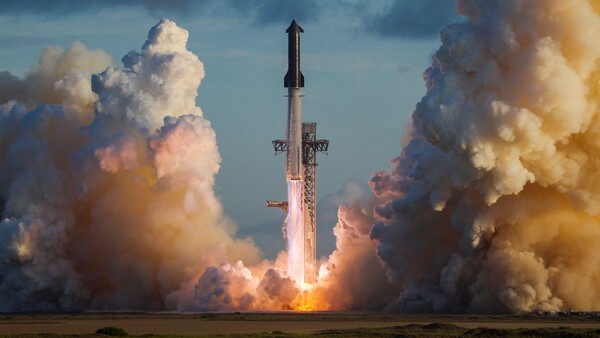
[Digital Today Seung-a Yoo, intern reporter] SpaceX on the 28th put Starship into orbit for the first time and deployed 26 next-generation Starlink V3 satellites.
Cryptopolitan and other foreign media reported on the 28th (local time) that on its 14th flight, Starship achieved its first orbital insertion and a commercial satellite deployment but ended the mission earlier than planned due to an engine anomaly.
Starship lifted off from Starbase, Texas, and during ascent one Raptor engine on the Super Heavy booster shut down earlier than scheduled. One Raptor engine on the Starship upper stage also shut down early. SpaceX extended the burn time of the other engines to continue the flight, and the flight control team proceeded with the orbital insertion burn after checking the vehicle’s condition.
Starship reached low Earth orbit at an altitude of about 276 km and deployed 26 Starlink V3 satellites one by one. The goal had been a roughly 10-hour flight making about six orbits, but engine problems ended the mission after about 3 hours. Starship later re-entered over the Pacific and splashed down at a planned point north of Hawaii.
The flight also marked the first commercial deployment of Starlink V3. Starlink V3 is too large to be carried on a Falcon 9, and each satellite weighs about 2 tonnes at launch. SpaceX said a single Starlink V3 satellite is designed to support 1 Tbps downlink and 160 Gbps uplink capacity for the Starlink network. Based on the 26 deployed, it can add up to 26 Tbps of network capacity. That is about 10 times the capacity of existing satellites launched on Falcon 9.
Starlink V3 carries solar panels with improved power generation and upgraded antennas to boost network performance. It can also be used for direct-to-device connectivity services and could be used in the future for SpaceX’s Starshield service for the U.S. government. SpaceX said it secured communications with all 26 satellites after separation.
The orbital insertion on this flight lays the groundwork for expanded Starlink V3 deployments and in-space refuelling tests. Starlink V3 satellites were launched on a Starship flight in July, but the vehicle failed to reach orbit and the satellites were lost after re-entering the atmosphere. With this flight, Starship succeeded in placing V3 satellites into orbit.
Starlink already holds a large share of the consumer satellite broadband market. According to Ookla, Starlink accounted for 97.1 percent of the global satellite Speedtest sample in the third quarter of 2025, while Viasat accounted for 1.7 percent. The figures are based on usage samples, not subscriber market share. SpaceX’s Starlink subscribers total about 10.3 million as of March 31, 2026.
The flight showed that Starship can place large satellites into orbit, but it did not prove whether it can maintain a sufficient launch cadence. SpaceX plans to increase the number of Starship launches, extend flight duration and test in-space refuelling.
The space industry is also expanding. Global space economy revenue in 2025 was estimated at about $626 billion, with about 78 percent coming from commercial activity. The Organisation for Economic Co-operation and Development (OECD) warned that growing dependence on space infrastructure could create strategic vulnerabilities from market concentration.
Low Earth orbit broadband is also expected to have large economic effects. Oxford Economics analysed that depending on policy, affordability of user fees and competition, the number of low Earth orbit broadband users could reach 78 million to 421 million by 2035, and could add $32 billion to $863 billion to global gross domestic product (GDP).
SpaceX plans to launch Starship more frequently and expand deployments of Starlink V3 satellites. Over the long term, it plans prolonged orbital flights for Starship and in-space refuelling tests, and based on that, it aims to secure technology needed for lunar landing missions under NASA’s Artemis program.
Splashdown confirmed. Congratulations to the entire SpaceX team on the first orbital flight of Starship! pic.twitter.com/urjmiwnvNl
 Seung-a Yoo
ysah@d-today.co.kr
Seung-a Yoo
ysah@d-today.co.kr