
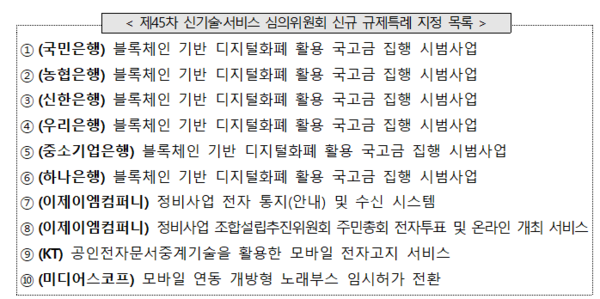
A pilot project will be launched to pay for government office operating expenses, including official entertainment expenses, using blockchain-based digital currency. Regulatory exemptions were also granted for electronic notices and online residents' general meetings in urban renewal projects, as well as a mobile electronic notification service.
South Korea's Ministry of Science and ICT said on Monday it designated a total of 9 pilot exemptions after holding the 45th ICT regulatory sandbox New Technology and Service Review Committee meeting in writing on Sept. 21.
The ministry designated as a pilot exemption a "treasury disbursement pilot project using blockchain-based digital currency" applied for by 6 banks, including KB Kookmin, NongHyup, Shinhan, Woori, IBK and Hana. Under the current National Treasury Funds Management Act, office operating expenses can be disbursed only through government purchase cards and other such means. The exemption will allow payments such as official entertainment expenses to be made with blockchain-based digital currency via a smartphone QR method instead of a physical card.
Two pilot exemptions related to urban renewal projects were also designated. EJM Company’s "urban renewal project electronic notice and receipt system" allows documents previously sent only by registered mail, such as notices convening an inaugural general meeting to establish an association, to be delivered as electronic documents. It requires registered mail to be sent as before to association members who do not agree to electronic notices, and follow-up notices if electronic notices are not confirmed.
EJM Company also received an exemption for its "electronic voting and online hosting service for residents' general meetings of an urban renewal project association establishment promotion committee". This will allow hybrid in-person and online residents' general meetings and electronic voting using a mobile platform. Electronic voting will apply to those who give prior consent. Safety measures will also be applied, including preventing leaks of personal information and voting results.
KT’s "mobile electronic notification service using certified electronic document relay technology" was also designated as a pilot exemption. Under current law, certified electronic document relays can distribute only electronic documents created by others. The exemption will allow them to distribute documents they create directly. KT will be able to send items such as bills, previously sent by mail, directly as mobile electronic documents.
The committee converted MediaScope’s "mobile-linked open karaoke booth", an existing pilot exemption project, into a temporary permit. The move followed the Ministry of Culture, Sports and Tourism’s judgment that related laws and regulations need to be reviewed for revisions.
Deputy Prime Minister and Science and ICT Minister Kyung-hoon Bae (배경훈) said, "We will actively provide opportunities for pilot testing so that innovative services do not face difficulties entering the market due to existing regulations, and we will cooperate with relevant ministries so that this leads to institutional improvements."
 Jin-ho Lee
jhlee26@d-today.co.kr
Jin-ho Lee
jhlee26@d-today.co.kr