
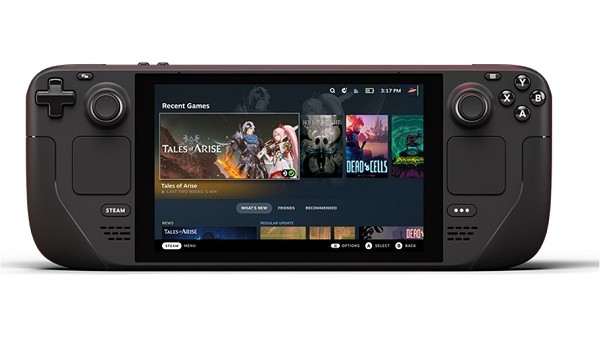
[DigitalToday reporter Jinju Hong] An analysis says Valve's next-generation handheld gaming PC, the Steam Deck 2, will need broad upgrades from its screen and performance to price, control durability and battery life to secure competitiveness in 2027. With rival specifications rising quickly, it will need to sustain the price-performance balance that helped the first-generation Steam Deck open the market.
Tech outlet TechRadar reported on Sept. 20 local time that the current Steam Deck is falling behind major rivals in screen resolution and performance. That has prompted analysis that Steam Deck 2 should improve core elements needed for a handheld device rather than simply boosting processor performance.
The first area cited is the display. The Steam Deck LCD and Steam Deck OLED both use 1280x720 resolution, supporting refresh rates of up to 60Hz and 90Hz, respectively.
Those specs were competitive when the Steam Deck launched, given the nature of a handheld gaming PC. Since then, more devices have come to market with 1080p or higher resolution and refresh rates of at least 120Hz. Rival products such as the Asus ROG Ally and Lenovo Legion Go are also emphasising higher resolution and refresh rates.
That has led to expectations that the Steam Deck 2 will need to support at least 1080p resolution and a refresh rate in the 120Hz class. Screen upgrades are expected to be an important factor not only for game graphics quality but also in competing on specifications with future high-performance handheld gaming PCs.
Performance also needs improvement. The first-generation Steam Deck used a custom AMD APU and focused on running games at about 30 frames per second in a 720p environment. More recent handheld gaming PCs are stepping up performance competition by using AMD Ryzen Z1 and Z2 series chips or Intel Arc G3 series APUs.
Still, it is difficult for Valve to bring desktop-level performance directly to a handheld device. Valve's recently introduced Steam Machine has a Zen 4-based 6-core CPU and an RDNA 3-based GPU with 28 compute units, and the company has said it delivers about six times the performance of the Steam Deck.
But the Steam Machine uses about 170W of power when plugged in. The Steam Deck OLED uses up to 45W when plugged in and operates in a range of about 4 to 27W on battery power. Given the nature of a handheld device, the Steam Deck 2 is seen as a more realistic choice if it improves power efficiency rather than simply pushing up absolute performance.
An analysis says that, considering the improved performance-per-watt of AMD's Ryzen Z2 series, one target could be a configuration that can stably maintain more than 30 frames per second at 1080p even in a low-power environment.
Price competitiveness is seen as an even more important task. The Steam Deck entered the market with Valve accepting a certain level of losses at launch. Gabe Newell (게이브 뉴웰), Valve's co-founder and CEO, has also explained that pricing was not easy at the time but played a decisive role in entering the market.
The strategy of offering sufficient performance at a low price was a key factor behind the Steam Deck's early success. Recently, however, the sharp rise in Steam Deck OLED prices due to factors such as higher memory prices, along with a drop in sales, has become a burden.
That is why there is a view that the Steam Deck 2 must also secure price competitiveness. The argument is that it should offer base and mid-tier models below $1,000 while keeping prices lower than rival products. With prices for high-performance handheld gaming PCs rising and increasing the burden on consumers, an analysis says Valve needs to make price a key weapon again.
Control durability has also been raised as an area for improvement. The existing Steam Deck offers a relatively stable grip during long gaming sessions, but has been criticised for the durability of its buttons and analogue sticks.
In particular, the existing sticks use a potentiometer design that can cause stick drift as wear accumulates. That has led to calls for the next-generation product to adopt TMR (tunnel magnetoresistance) sticks, which use magnetic sensing. The TMR method offers high sensitivity and accuracy, and component prices have recently been falling, making it easier to apply to handheld gaming devices, it said.
Battery capacity is also a task to solve alongside performance improvements. The existing Steam Deck has a 40Wh battery, while the Steam Deck OLED has a 50Wh battery. Official battery life is about 2 to 12 hours depending on the game, but in many cases actual play time for high-spec games remains about 2 to 4 hours.
Rival products are pushing larger batteries. The Asus ROG Ally X has an 80Wh battery, securing longer use even for high-performance games. If the Steam Deck 2 raises resolution and performance, power consumption may also rise, making it necessary to address both larger battery capacity and improved power efficiency.
Ultimately, an analysis says the Steam Deck 2's competitiveness depends on balance rather than a simple fight for top-end specifications. The first-generation Steam Deck drew attention not because it had the most powerful hardware, but because it delivered a sufficient PC gaming experience at a relatively less burdensome price.
If the Steam Deck 2 appears in the market in 2027, a 1080p, 120Hz-class display, improved performance-per-watt, reasonable pricing, more durable controls and a higher-capacity battery are expected to be key competitive factors. Attention is focused on whether Valve can carry over the first-generation Steam Deck's formula of being a 'sufficiently powerful yet accessible handheld PC' into the sequel.
 Jinju Hong
hongjj@d-today.co.kr
Jinju Hong
hongjj@d-today.co.kr