
Six months after autonomous trucks began carrying freight on expressways, the efficiency gains from operations have yet to fully materialise. Although mainline expressway driving has entered a stable phase, off-road segments remain unchanged, including duplicate staffing, terminal entry, loading and unloading, and determining responsibility in accidents. The industry says the timing for shifting to unmanned autonomous driving depends more on on-site conditions than on technological completeness.
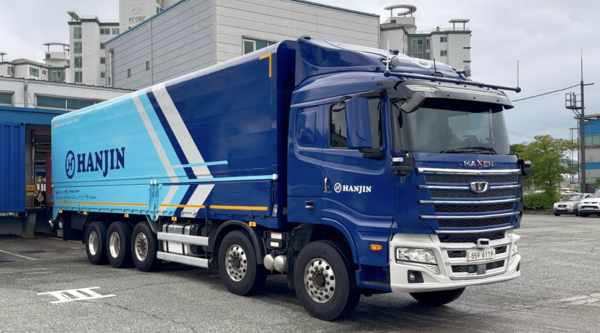
In April, RideFlux received permission from the Ministry of Land, Infrastructure and Transport for paid autonomous freight transport on long-distance routes that include general urban roads. In June, it signed a contract with Lotte Global Logistics and deployed autonomous parcel trucks on a 112 km route linking the Seoul Southeast Logistics Complex and Lotte Parcel’s Jincheon Mega Hub Terminal. From July 1, it has also operated a one-way 116 km route with Hanjin Parcel from Gunsan to Daejeon via Jeonju. On both routes, Tata Daewoo Mobility’s Maxen truck runs at a top speed of 90 km per hour.
Now, six months after gaining approval, the assessment is that it has not fully captured operating efficiency for autonomous trucks. For one thing, the driver’s seat is still not empty. On RideFlux routes, a test driver rides in the driver’s seat while the vehicle operates. The industry believes that at the current stage, which requires emergency-response personnel to be onboard, costs overlap between existing driving staff and safety personnel, meaning the goal of easing labour shortages is only half met.
An industry official said, "For straight highway driving or simple trunk routes, software maturity has already risen to the point where fully hands-off operation is possible," adding, "But from the customer’s perspective, there is no choice but to feel the burden of double labour costs including safety personnel."
Safety personnel currently must complete autonomous-driving safety training of a certain minimum duration, meaning existing freight drivers cannot be assigned immediately. Existing freight drivers also spend a large share of their work supervising loading and unloading and securing cargo, but safety personnel, who are autonomous-driving technical staff, do not want to take on such physical tasks. Existing drivers, in turn, feel burdened by system monitoring.
As a result, sites introduced autonomous driving with the goal of cutting the number of drivers, but instead of replacing drivers they effectively need to add separate specialised staff to monitor the autonomous system. The official added, "For now, it is very difficult to prove commercial viability," and said, "Even if conditional, it would be good to actively expand fully unmanned pilot sections."
◆Double labour-cost burden from onboard safety personnel… terminal docking and accident liability determination needed
Another factor setting the pace of unmanned operation is the issue of assigning responsibility when accidents occur. The industry believes it is not easy to determine whether an incident stems from road infrastructure problems such as communications failures or from the autonomous-driving algorithm’s decision-making. Discussions are under way to expand the data fields recorded by event data recorders (EDR), but for now the legal burden borne by logistics companies remains.
Even though revisions to the Autonomous Vehicle Act have created an institutional foundation to commercialise certified vehicles, once freight transport began, problems emerged in areas other than autonomous-driving technology. The reason approval was granted in the first place was that the operating routes are suitable for autonomous driving. These segments run between logistics centres and terminals, repeat the same roads daily and are mostly expressways. According to CJ Logistics, about 97 percent of middle-mile transport segments are expressways.
Problems also persist after arrival. The industry says that while trunk-line driving has entered a stable phase, entering narrow areas of logistics centres and parking tightly at loading and unloading docks is often done by a person getting out and taking manual control. Even when using unmanned transfer robots, differing communications standards between the robots and trucks mean additional personnel must be assigned to support unloading and disembarkation work.
Separate from the need to overhaul systems, the pace of business toward unmanned operation is accelerating. On Sept. 3, RideFlux signed a memorandum of understanding with commercial vehicle maker Tata Daewoo Mobility to jointly develop a Level 2+ driver-assistance system and to commercialise a Level 4 autonomous truck business. Under the arrangement, Tata Daewoo Mobility provides platforms for the heavy-duty Maxen truck and the medium-duty Gusen truck, as well as a vehicle control interface, while RideFlux layers in expressway-driving software.
It has already provided paid freight transport since July on Hanjin’s Gunsan-Jeonju-Daejeon route, and the two companies plan to establish a roadmap for mass production of fully unmanned Level 4 trucks. RideFlux CEO Joonghee Park (박중희) said, "It is a milestone to expand beyond a government pilot-centred business structure into the private B2B market of mass production by completed-vehicle makers." RideFlux plans to shift to fully unmanned operation after a phase in 2027 with a passenger riding in the front seat.
Logistics companies that operate terminal networks are moving inward from expressways into hubs. CJ Logistics will begin autonomous freight transport from October with the Daegu Metropolitan City government and the Korea Intelligent Automotive Parts Promotion Institute, linking 4 sub-terminals in the Daegu area. It is an urban segment with short distances of 4.2 to 26 km between hubs, and frequent traffic signals and pedestrians. The company said the effort is meaningful in confirming the suitability of the overall process, covering not only vehicle performance but also transport planning and terminal work.
 Daegeon Seok
d2dg@d-today.co.kr
Daegeon Seok
d2dg@d-today.co.kr