
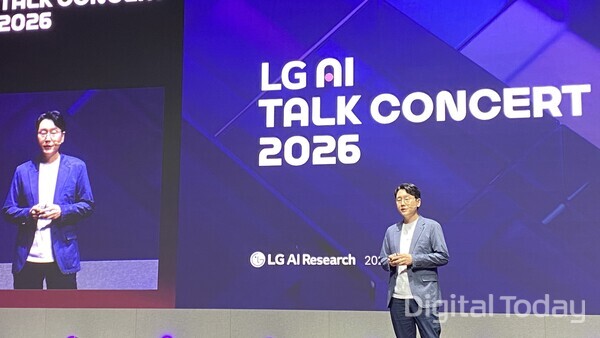
LG AI Research has set out a strategy for competing in artificial general intelligence (AGI) that differs from global big tech. It aims to keep boosting general model performance while implementing expert intelligence that can surpass general AGI in specific domains such as manufacturing, science and finance, and use it to solve industry problems through what it calls "Expert AI".
LG AI Research held "LG AI Talk Concert 2026" on Sept. 14 at LG Sciencepark in Magok, Seoul. It unveiled its Expert AI strategy, applications by industry and future directions for AI technology development.
Lim Woo-hyung (임우형), co-head of LG AI Research, said EXAONE is not different from global trends and directions in AGI technology development. He said the ultimate goal is Expert AI that solves problems in industry settings, and that it will continue to upgrade foundation model performance to do so.
Lee Hong-rak (이홍락), co-head of LG AI Research, said the goal is to build the most efficient and useful model for enterprises by combining a sufficiently smart model with internal corporate information and domain-specific information, rather than building an AGI model itself for global competition.
The core of LG AI Research's strategy is combining general models with industry-specific expertise. It aims to build AI with deeper expertise than general models in certain areas by adding private data accumulated in the field, work context and expert know-how.
Lim said in industrial settings it is not enough to simply produce plausible answers. He said there is a need for AI that can understand and judge numerous variables and even 1 percent of anomalies.
He stressed that what matters more than building and introducing AI is improving work efficiency, cutting costs and improving productivity and quality so it leads to tangible corporate results.
To that end, LG AI Research is developing in parallel the EXAONE model series focused on economic feasibility and usability, domain-specific models for areas such as healthcare, science, manufacturing and finance, and K-EXAONE aimed at global frontier-level performance.
It is also widening its technological scope to agent AI that goes beyond foundation models by defining problems, planning solutions and then acting directly.
A flagship example is "EXAONE Data Foundry", a platform that creates specialized tuning data using internal domain documents and small amounts of data, and uses it to develop expert models. LG AI Research plans to develop it into an "AI Foundry" in which AI performs everything from data generation to model development and evaluation on its own.
EXAONE Data Foundry was also used to develop AI for drug review at the Ministry of Food and Drug Safety. AI translates and summarises vast new drug materials and compares and verifies them against previously approved products. LG AI Research expects this will allow experts to reduce repetitive work and focus on key judgments and decision-making.
Manufacturing, science and finance test 'Expert AI'
In manufacturing, it is aiming for an environment in which AI predicts abnormal signs first and takes necessary measures pre-emptively, moving away from responding only after problems occur.
"EXAONE Tabular", a model specialised in structured data, analyses manufacturing-site data such as temperature and pressure, process conditions and quality inspections. It identifies relationships and patterns among variables and predicts the likelihood of defects and optimal production conditions. It was trained on more than 100 million table data points so it can be used in new areas with limited data without additional training.
EXAONE Tabular ranked first in classification and multi-categorical prediction and second overall on the global structured-data leaderboard "TabArena". It is also expanding its use to the energy sector, including forecasting power generation and electricity consumption.
In vision inspection, it is also developing a foundation model that can be applied to new inspection targets using only images and prompts, moving away from the previous approach that required retraining a model whenever products or production lines changed. AI agents autonomously carry out data sampling and labeling and model training.
In science, it is focusing on using AI to reduce trial and error in research and speed up discoveries.
A representative case is that it reviewed more than 420,000 candidate substances with LG Household & Health Care using "EXAONE Discovery" and found promising candidates in a day. It typically takes about 22 months to develop a single cosmetic ingredient, but it greatly reduced the time needed to search for initial candidates.
LG AI Research is also building an "AI autonomous laboratory" that conducts experiments and learns on its own 24 hours a day. When a foundation model for materials development predicts synthesis results for new materials, robot arms and automated equipment conduct experiments, and AI learns the results again to design the next experiment.
In healthcare, it is developing a cancer treatment agent with Vanderbilt University Medical Center in the United States based on the pathology image analysis model "EXAONE Path". It aims to design personalised treatment strategies by integrating tissue pathology images, genetic information and drug response data, and reduce a process that took an average of more than 4 weeks to a day.
It is also expanding future forecasting technology using Expert AI in finance. The LQAI ETF, to which LG AI Research AI technology is applied, was listed on the New York Stock Exchange in November 2023, and AI manages it by selecting 100 stocks every 4 weeks from among 500 large-cap U.S. stocks.
It is also providing to global investors, through London Stock Exchange Group (LSEG), a finance-focused solution called "EXAONE Business Intelligence" in which multiple AI agents handle everything from data analysis to inference, forecasting and explanation. This year it is expanding the service to the domestic market in cooperation with Koscom.
LG AI Research is putting Expert AI at the forefront while also competing in global frontier models. Through the K-EXAONE project, it is developing high-performance models that strengthen agent capabilities for complex tasks, reasoning, understanding of Korean and specialised knowledge, and execution efficiency.
Robot foundation models are also a key pillar. It is aiming for a structure in which an AI orchestrator goes beyond automation of individual robots by grasping the status of an entire factory and linking robots, inspection facilities and optimisation modules to run the factory on its own in line with production goals.
"Development will continue...but releases and deployment will be more cautious"
On the "slowdown in development" debate that has emerged as a major topic in the AI industry, LG AI Research said it believes safety should be ensured in social acceptance and the actual process of launching and deploying, rather than slowing technology development itself.
Lim said the reality is that concerns coexist as social change can occur rapidly as AI development speeds up. He said he sympathises with those concerns, but AI development should continue.
He added that deep consideration is needed about how to use AI to prevent social problems and how society will accept the pace of AI technology development.
Lee said it is difficult to view global AI companies as actually slowing their research and development pace.
He said he understands there is still no evidence that they are reducing internal development speed. He said he would expect acceleration, not deceleration, in terms of compute and R&D.
He said that at the release and deployment stage, various reviews are needed, including cautious external testing, taking into account model risks and the possibility of cybersecurity attacks. He said it needs to be watched closely as it is an area that keeps changing.
 Seul-gi Son
sageson@d-today.co.kr
Seul-gi Son
sageson@d-today.co.kr