
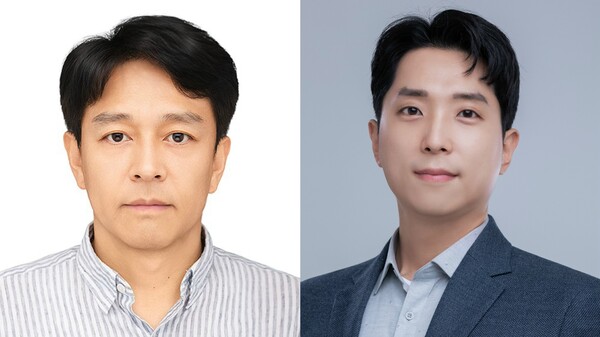
South Korea's Ministry of Science and ICT and the Korea Industrial Technology Association said on Sept. 14 they selected Exosystems CEO Lee Hoo-man (이후만) and LG Display engineer Jeon Chang-hoon (전창훈) as winners of the September 2026 Korea Engineer Award.
The Korea Engineer Award selects engineers who contribute to technological innovation in industry. Winners receive an award from the deputy prime minister, who is also the science minister, and prize money of 5 million won.
Lee was recognized for developing digital biomarker technology that uses AI to help diagnose sarcopenia.
Exosystems was founded in 2017 through a lab startup support program run by the science ministry by a researcher at the Electronics and Telecommunications Research Institute (ETRI). Lee has continued developing digital biomarker technology for neuromuscular function assessment and rehabilitation, and has registered more than 15 domestic and overseas patents related to the technology.
Existing sarcopenia diagnosis requires separate measurements of muscle mass, muscle strength and walking speed, which takes time and money and is difficult to apply to patients with limited mobility.
Lee developed muscle function index (MFI) technology that quantifies neuromuscular function by using AI to analyse evoked surface electromyography signals, which are muscle signals that respond to stimuli at various frequencies. The AI algorithm learns changes and patterns in muscle signals according to stimuli and converts them into an indicator that can be used to assess sarcopenia.
Software that applies the technology to help diagnose sarcopenia was designated as an innovative medical device by the Ministry of Food and Drug Safety in 2024, and the related technology received New Excellent Technology (NET) certification in 2025.
Lee said, "I hope technology that can measure neuromuscular function easily and objectively will provide practical help in rehabilitation settings." He added, "I will advance the technology and contribute to strengthening the competitiveness of South Korea's digital healthcare industry."
Jeon won for developing AI-based optical correction technology for OLED panels.
OLED offers high contrast and colour expression because each pixel emits light directly, but small deviations in the thickness of organic materials or the performance of electrical switches in the production process can lead to non-uniform picture quality.
Jeon developed technology to measure and correct the degree of non-uniformity of a display screen using camera images, and applied image quality correction technology that uses a CNN-based AI model to predict original high-resolution images.
According to the science ministry, the technology improved OLED picture uniformity by more than 100 percent and cut correction time by more than 75 percent in ultra-low luminance environments of less than 0.01 nit. Based on 0.01 nit, the defect rate fell to less than 0.5 percent after the technology was applied, from about 40 percent before it was applied.
Jeon said, "Based on the technological innovation capabilities and experience we have built up, I will work so that the domestic OLED industry can lead the global market and strengthen competitiveness in future technologies."
 Seulgi Son
sageson@d-today.co.kr
Seulgi Son
sageson@d-today.co.kr