
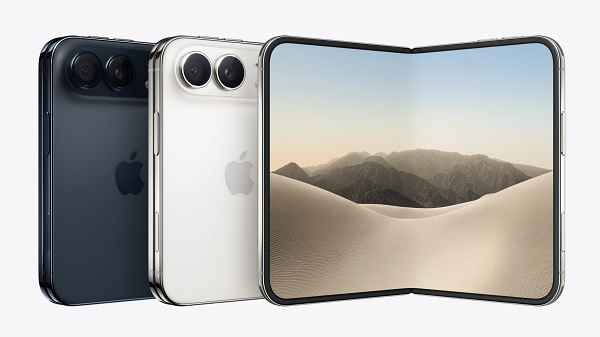
A claim has emerged that Apple, having proven with the iPhone Duo that it can build a foldable smartphone, should consider a smaller flip-style iPhone and a larger foldable iPad as its next steps.
On Sept. 11 local time, IT outlet Engadget said the arrival of the iPhone Duo signals that Apple's foldable strategy has entered an early stage and that it needs to expand follow-on products.
The key is what comes next rather than the iPhone Duo itself. Despite its high price of $1,999 (about 2.68 million won), the iPhone Duo showed Apple has secured the design capability to combine an ultra-thin device with a sturdy hinge. It also showed Apple did not hesitate to follow foldable designs from Samsung Electronics and the Android camp. Engadget said that if this is the direction, Apple could also follow a compact, horizontal fold model like Samsung's Z Flip.
The reason compact foldables are discussed first is mass appeal. They are less burdensome on price than large book-style foldables, and their use is more familiar. Engadget said compact foldables have effectively become everyday product lines after gaining a foothold in the market for 6 years. It noted such products often sell for about half the price of large foldable smartphones. The outlet also said use cases for the Z Flip or the Motorola Razr are seen more often even among non-expert users.
A direction for an iPhone flip was also laid out in detail. The basic framework is based on existing iPhones, with the top folding horizontally. It said a small external display would be needed to check notifications, perform simple tasks and take selfies using the rear camera. Engadget said one can think of the iPhone 17 and imagine folding the upper part like older flip phones.
The claim is also linked to changes in Apple's next iPhone design. There is speculation Apple is preparing a major redesign to mark the iPhone's 20th anniversary next year, but Engadget said a bezel-less curved display alone would be unlikely to draw a big response. By contrast, it said an iPhone flip that easily fits into a pocket or small bag could create new demand.
On the large-screen foldable side, the iPad was presented as a candidate. Software, rather than hardware, was cited as the strength here. The claim is that extending to tablets the multitasking and folded-screen function placement seen in the iPhone Duo could allow a stronger start than Asus and Lenovo, which make devices based on Windows 11. Engadget said Apple showed signs of deep consideration about how to arrange apps and functions across foldable screens and assessed that, as always, it has a software advantage.
Two forms were proposed for a foldable iPad. One approach is to place an iPad mini-class screen on the outside and a larger screen inside. It said an option of omitting an external display altogether is also possible, given cost issues. Use would focus on serving as a laptop replacement. Fully unfolded, it would be used like a regular iPad, and when folded in half the top would be the display and the bottom would serve as a haptics-based touch keyboard area. Multitasking examples included putting YouTube on the top while handling Slack and handwritten notes at the same time on the bottom.
On size, a view was presented that smaller than 16.3 inches would be sufficient. Asus and Lenovo have applied 16.3-inch OLED screens to foldable tablets, but Apple would not need a screen that large, it said. It said a 13-inch foldable iPad Pro would remain practical even when folded in half, and an 11-inch model could be used like a portable journal device.
It also noted that a foldable iPad would be difficult to realize in the short term. Refining the product structure could take years, and demand is not large for now. But it said the situation is different for an iPhone flip. Engadget said that because Samsung Electronics has already done much of the groundwork for the market, Apple would only need to follow that framework. It said this suggests that after the iPhone Duo, Apple's foldable strategy could be tested first in mainstream compact foldables rather than experimental large products.
 Jinju Hong
hongjj@d-today.co.kr
Jinju Hong
hongjj@d-today.co.kr