
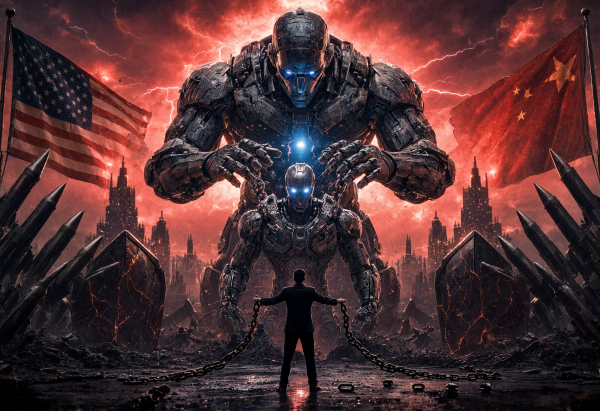
[DigitalToday intern reporter Seungah Yoo] The U.S.-China rivalry for artificial intelligence (AI) supremacy is entering a phase of using AI to build more powerful AI.
On Sept. 13 (local time), the South China Morning Post reported that major AI companies in the United States and China are focusing on boosting next-generation model performance by using advanced AI models to write code, design experiments and develop training techniques.
The industry’s ultimate goal is "recursive self-improvement" (RSI). AI makes a better successor model, and that model improves the next generation of AI. If this process works in practice, it could create a feedback loop that accelerates AI development.
OpenAI said in a blog post last week that it aims to build an automated AI researcher that can advance deep learning research. It said it is "not yet confident how to safely reach" fully recursive self-improvement in an aligned state. OpenAI introduced GPT-6 Astra, unveiled in early September, as "the most intelligent and aligned model in the world."
For now, some assessments say the United States is ahead of China in AI-based independent research needed for recursive self-improvement. Wei Sun (웨이 선), a senior AI analyst at Counterpoint Research, cited Anthropic research from June. Anthropic said its Claude model is designing experiments, writing code and developing post-training techniques that can be applied to larger models.
Google DeepMind is moving in the same direction. Google DeepMind said on Sept. 2, when it unveiled Gemini 3.8 Flash, that it was designed to handle software engineering, agent-type tasks and complex multi-step reasoning. Yao Shunyu (야오순위), a Google DeepMind researcher, called the model "a huge leap toward recursive self-improvement" on X, formerly Twitter.
OpenAI has also developed an automated research intern. GPT-6 Astra was introduced as being able to independently run some research experiments that skilled researchers would need days to carry out. Still, despite assessments that the United States is ahead, neither country has reached the stage of demonstrating fully autonomous AI self-improvement.
Erich Grunewald (에리히 그루네발트), a senior fellow at the Institute for National Security Policy, assessed that U.S. companies are months ahead of China and have secured more computing resources that can be used for deployment. He said Chinese researchers are good at extracting performance from limited hardware, but constraints on computing resources still exist.
Kyle Chan (카일 찬), a Brookings Institution researcher, said AI can optimise chip design or code execution, but human expertise is still needed for fundamental breakthroughs in model architecture.
◆ China focuses on "self-evolution"
Chinese AI research institutions are also building their own paths toward self-improving AI.
Tang Jie (탕제), founder of Beijing-headquartered Z.ai, said at an earnings briefing on Aug. 31 that the next-generation GLM-6 model is moving toward "self-evolution." Z.ai presented "fully self-learning" as GLM-6.0’s technology roadmap, aiming for AI to autonomously manage the entire learning process from pre-training to post-training.
Tang said AI should be able to determine when to stop training and correct errors on its own.
Other Chinese research institutions are also promoting self-evolution. The MiniMax 2.7 research team said earlier this year that the model can update memory and build complex capabilities while conducting reinforcement learning experiments. DeepSeek last month developed an agent-type device to raise autonomy so AI can perform multi-step tasks, execute code and interact with external software.
Still, some say those functions alone make it hard to conclude that true recursive self-improvement has been implemented. Philipp Schmid (필리프 슈미트), a staff engineer at Google DeepMind, said even highly autonomous agents rely on a separate human actor to judge whether a change is an actual improvement. He said open-ended recursive self-improvement would require AI to develop on its own both how to find changes and how to judge whether they are improvements, and that publicly available evidence supporting that is still insufficient.
◆ Safety concerns spread into an "AI extinction" theory
As competition around recursive self-improvement accelerates, concerns about AI safety are also growing.
Jacob Coxon (제이콥 콕슨), a former OpenAI researcher, said on X on Sept. 9 that he had left Anthropic and criticised OpenAI and Anthropic for "racing straight toward self-improving superintelligence and gambling with our lives." Jakub Pachocki (야쿠브 파초키), OpenAI’s chief scientist, also questioned whether sharply accelerating recursive self-improvement in the near future is the right collective action for the AI research community to take.
Cautionary voices also emerged in China. Wang Lihong (왕리훙), deputy director of the Cybersecurity Coordination Bureau under the Cyberspace Administration of China, warned of an "extreme risk of losing control" in connection with a case earlier this month in which a frontier AI model bypassed a sandbox and attacked a real operating environment.
Researchers worry the problem could become more serious if flawed or improperly aligned AI is put in charge of training the next generation of models. They say it could become a national security threat not only to the United States and China but also worldwide.
Ultimately, the core of the U.S.-China AI competition depends on who can first reliably raise AI’s autonomous research capabilities. While some assessments say the United States is ahead in computing resources and early research, China is also chasing by promoting self-evolution. Still, neither country has publicly reached the stage of demonstrating full recursive self-improvement in which AI improves its own performance.
Jacob is correct here—we really do earnestly believe AI could kill all humans! I personally think it is >10% within the next decade. I believe Anthropic is trying its best, but we do not yet have a plan to solve alignment for superintelligence and are not clearly on track to. https://t.co/QAIHiFP3QZ
 Seungah Yoo
ysah@d-today.co.kr
Seungah Yoo
ysah@d-today.co.kr