
[DigitalToday reporter Suk Dae-geon (석대건)] Competition in the humanoid robot battery market is shifting from capacity to operating uptime. As larger batteries make robots heavier, making it hard to increase capacity, companies are competing on technologies to boost uptime through swapping and fast charging.
Industry estimates for the humanoid market have recently been revised up in succession, prompting changes in robot battery strategies at related companies, the industry said on Sunday.
Goldman Sachs sees the global humanoid robot market growing to $38 billion by 2035. That is more than six times its previous $6 billion forecast. It expects annual shipments in 2030 to exceed 250,000 units. Morgan Stanley forecasts that more than 1 billion humanoid robots will be deployed by 2050 and the related market will grow to $5 trillion.
Battery demand for robots is set to rise, but most humanoid batteries currently remain small packs. TrendForce said most humanoid batteries are under 2 kWh and run for 2 to 4 hours. Unitree's G1 humanoid robot also operates for about 2 hours. Replacing humans in industrial settings requires at least an 8-hour shift.
Weight constraints are keeping humanoid batteries in small packs. The heavier the battery, the more power the robot uses when it moves. Academic research by the Institute of Electrical and Electronics Engineers (IEEE) and others says a 70-kg robot must limit its battery pack to 5 to 8 kg to maintain balance. Commercial lithium-ion cells have an energy density of 250 to 300 Wh per kg, but the effective density falls when the weight of the battery management system and packaging is included. Research has also proposed designs that distribute small high-power batteries or capacitors near joints that consume large amounts of power.
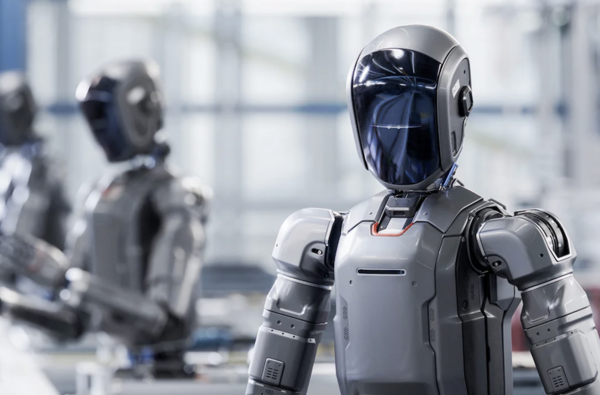
Companies are responding by integrating batteries into the torso or swapping them out to address operating-time limits. Tesla's Optimus and Figure AI's Figure 03 integrated a 2.3 kWh battery into the torso structure. Figure 03 runs for up to 5 hours and supports 2 kW fast charging. This approach can reduce space and weight, but it is difficult to operate the robot while charging.
By contrast, Boston Dynamics' Atlas runs for about 4 hours in normal work and then replaces its own battery in 3 minutes. UBTECH's Walker S2 also uses an automatic swap method that takes about 3 minutes and aims for 24-hour continuous operation. IBK Investment & Securities analysed this as a strategy that uses multiple batteries and swap stations to reduce both robot weight and downtime.
For cell makers, annual production would need to rise to tens of millions of units for humanoids to become a meaningful new source of demand. IBK Investment & Securities said that producing 100 million units a year would require 300 GWh of batteries. That is equivalent to 5 million electric vehicles with 60 kWh packs and 25 percent of last year's EV battery shipments. It said early investment points include high-power small packs, BMS, thermal management components, high-current connectors and automatic swap systems.
Swappable batteries and all-solid-state batteries are cited as technologies that could overcome operating-time limits. TrendForce named the two as key solutions and predicted that demand for all-solid-state batteries driven by humanoids would rise to 74 GWh in 2035, more than 1,000 times the level in 2026.
Strategies among South Korea's three battery makers for robot batteries are split into three tracks: optimising cylindrical cells, co-developing with automakers, and swappable standards. Most humanoid companies source cylindrical or pouch cells used for EVs and design packs and BMS themselves. In line with that, LG Energy Solution is optimising its mass-produced 2170 cylindrical batteries for robots and is preparing to respond by splitting cells into versions for long-duration operation and for short bursts of high power.
Samsung SDI is co-developing robot batteries with Hyundai Motor Group, targeting mass production in the second half of 2027. At InterBattery 2026, it unveiled a pouch-type all-solid-state battery for physical AI for the first time. It is also supplying tabless high-nickel cylindrical batteries for robots. SK On formed a consortium with Yuil Robotics and others and is participating in a government-backed project to develop swappable standard battery technology for humanoids. It has also begun developing hot-swap technology for immediate replacement when discharged and high-power all-solid-state cells.
 Suk Dae-geon
d2dg@d-today.co.kr
Suk Dae-geon
d2dg@d-today.co.kr