
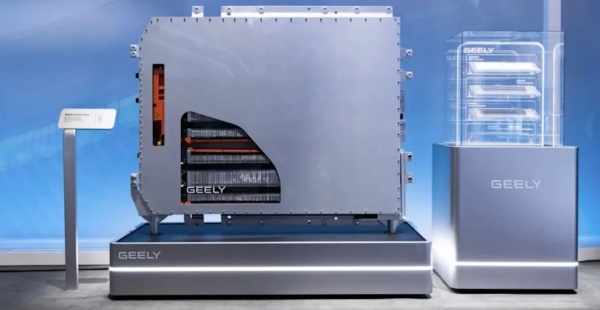
[DigitalToday reporter Jinju Hong (홍진주)] China's Geely Auto is accelerating development of next-generation solid-state batteries targeting energy density of up to 500 Wh/kg. Geely plans to conduct validation in real vehicles from 2026 and begin pilot application from 2027 for major brand models.
On Aug. 20 local time, electric vehicle outlet Electrek reported that Geely is developing solid-state battery cells targeting energy density of up to 500 Wh/kg and is already carrying out road tests of vehicles equipped with the battery.
The key is energy density. High-nickel NMC battery cells used in mass-produced electric cars are generally known to have energy density of about 250 to 300 Wh/kg. Tesla's 4680 battery is also about 245 Wh/kg, and LFP batteries are lower. In real vehicles, energy density per unit weight for the entire system falls further as cells are assembled into modules and packs.
If Geely's target is achieved, it would significantly raise energy density compared with existing mass-produced batteries. Geely aims for an electric car equipped with a 500 Wh/kg-class battery to secure driving range comparable to a diesel vehicle and to travel more than 1,000 km on a single charge. It put battery life at up to 1 million km.
Development is being carried out within Geely Holding. Geely Holding owns brands including Geely, Zeekr and Lynk & Co, as well as Volvo, Polestar, Lotus and Smart. The company plans to push ahead with pilot application of solid-state batteries in 2027 for vehicles across these brands.
Cooperation related to battery materials is also under way. Dow Chemical developed an adhesive for solid-state cells, and Dow's chief technology officer Bo Tong said the material maintains stability from minus 40 degrees Celsius to 120 degrees Celsius. It has also moved to develop materials to secure temperature stability, one of the key challenges for solid-state batteries.
Still, pilot application in 2027 does not mean mass production. Pilot production is closer to a step to check whether cells can be produced repeatedly and stably in limited volumes and to verify performance and yield. Geely has not yet specified a timeline for mass production or for securing price competitiveness.
Technical details also remain undisclosed. Geely has not said whether the solid-state electrolyte is sulfide-based or oxide-based, and it has not specified the anode material either. In particular, some point out that materials are not clear on whether the 500 Wh/kg figure is on a cell basis or a pack basis. The 1 million km lifespan has also not been backed by third-party verification data disclosed so far.
Competition in solid-state batteries is also intensifying across China's battery industry. CATL is targeting pilot production of a 500 Wh/kg-class sulfide-based solid-state battery in 2027, and BYD is also pushing a solid-state battery demonstration aimed at the same period. Japan's Toyota has also previously set a target of launching vehicles equipped with solid-state batteries in 2027 to 2028.
In China, electric cars equipped with semi-solid batteries are already being sold, but fully solid-state batteries at around 500 Wh/kg remain an industry-wide target at the pilot stage.
Ultimately, the key comes after on-road validation. The central issues are whether Geely's stated 500 Wh/kg energy density and 1 million km lifespan can be maintained in a mass-production environment, and how much production yield and costs can be reduced. If the targets are realised, major changes are expected in electric vehicle design and the competitive landscape, including achieving the same range with less battery weight or enabling long-distance driving of more than 1,000 km with the same battery weight.
 Jinju Hong
hongjj@d-today.co.kr
Jinju Hong
hongjj@d-today.co.kr