
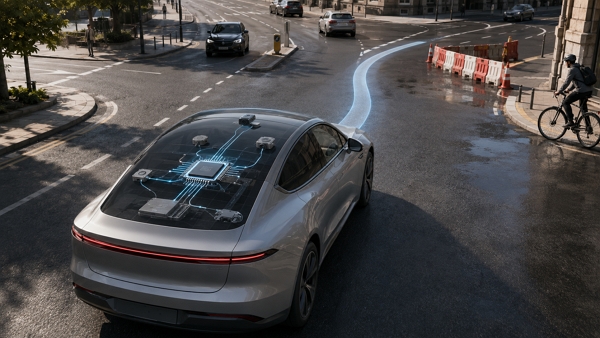
The competitive axis in the auto industry is expected to move beyond software-defined vehicles (SDVs) to AI-defined vehicles (AIDVs). An analysis said competitiveness could hinge less on what software is installed in a vehicle and more on how accurately it understands and responds to surrounding roads, the driver and driving conditions.
On Aug. 19, TomTom Chief Product Officer Leo Sei (레오 세이) argued in a contributed article to IT outlet TechRadar that "the auto industry is entering a new turning point centered on AI". In the past, mechanical performance such as horsepower, cylinders and torque determined a new car's competitiveness. Recently, the importance of driver-assistance functions, electric-vehicle driving range, digital experiences and connected services has grown, he wrote.
The foundation is SDVs. Vehicles with centralized computing and always-on connectivity can receive software updates and add new services after they leave the factory. As the coupling between hardware and software loosens, vehicle functions can be improved continuously. Sei said the industry is taking a step further, evolving into AIDVs in which performance and behavior are determined by continuously learning machine-learning models rather than prewritten rules.
The use of AI is not limited to autonomous driving. It can be applied across vehicles, including navigation and infotainment, battery and energy management, and climate-control systems. Qualcomm and Nissan have also mentioned the AIDV concept this year, presenting as the next technology trend a direction in which vehicles recognize and learn from surrounding environments and occupants' conditions and adapt to them.
Sei highlighted context data as the key. Vehicles that use only sensors respond based on the current situation detected by cameras or radar. He argued that combining this with high-definition maps and road information can help vehicles anticipate situations beyond the driver's view, including lane splits, speed-limit changes, road closures and potential risks. That could reduce sudden braking or steering corrections, enabling more natural driver assistance, he wrote.
AI is also used to create road data itself. By analyzing aerial and satellite images, vehicle signals and GPS movement patterns to automatically identify information such as lane structures, road markings and stop signs, it can lower the cost of building and updating high-definition road models. Sei forecast, "In the future, automakers' bottleneck will move away from simply building better AI models to how extensively they can supply the models with reliable, up-to-date context data."
AIDVs are closer to adding AI on top of SDVs than replacing them. Automakers will use a common computing and data foundation while trying to differentiate themselves in driving feel, user interfaces and driver-assistance functions. The standard for competition is also increasingly likely to shift from "how many functions have been added" to "how well the car understands and responds to situations."
 Choi Jae-won
ittt_0801@d-today.co.kr
Choi Jae-won
ittt_0801@d-today.co.kr