
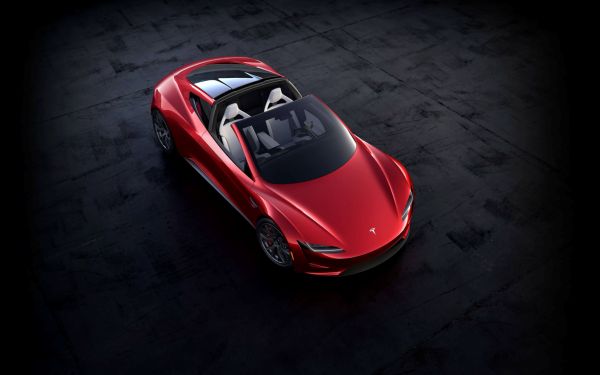
The application of SpaceX hovering technology has been cited as the reason behind the prolonged delay of Tesla's next-generation Roadster.
On Aug. 19, electric vehicle outlet Electrek reported that former Tesla president Jon McNeill (Jon McNeill) said the next-generation Roadster project is moving to strengthen the bond between Tesla and SpaceX, beyond simply developing a new car.
McNeill also mentioned Tesla's planned Roadster demonstration event, saying the vehicle's most extreme functions could be revealed. "I don't know if we'll see it take off, but I think we'll see it hover in this demo," he said. The feature is based on a cold-gas propulsion system developed by SpaceX, with the internal codename A71. It lifts the vehicle by firing thrusters toward the ground.
Until last week, there was speculation that Tesla could hold a so-called flying Roadster demonstration this month. The demo vehicle is likely to be remotely operated without a driver, it was reported. That is because the thrusters are loud enough to damage the hearing of people near the vehicle.
McNeill also linked the Roadster's role to the mood inside Tesla. "Elon Musk knows Tesla needs to bring energy and excitement back into its car business," he said. He also described the Roadster as "perhaps an unhidden attempt" to more tightly tie together the futures of Tesla and SpaceX. He added that the two companies "will come together sooner than people think."
The Roadster was unveiled in November 2017. Tesla promised production in 2020 and took deposits of up to $50,000, about 70 million won, from reservation buyers. Founders Series buyers wired the full $250,000, about 350 million won. Performance figures presented at the unveiling were 1.9 seconds from a standstill to 60 miles per hour, a top speed above 250 miles per hour, and a range of 620 miles on a single charge. The specifications at the time did not include SpaceX thrusters.
The development direction later changed after Musk mentioned a SpaceX package adding cold-gas thrusters. The package was introduced as being able to cut acceleration from a standstill to 60 miles per hour to about 1.1 seconds. The Roadster has since been delayed at least nine times. The demo schedule was pushed back to August 2026 after being moved from April 1, 2026 to late April, and after a comment made during a first-quarter earnings call that "it might be possible within a month." Thruster development work is now being cited as the direct reason for the preparation delay.
The demonstration plan itself has also been scaled back. An early concept reportedly included racing down a magnetised ramp, driving upside down, righting itself again and then hovering. But parts of it were removed after being reported to Musk. He was reported as saying of the demo, "It's hard to do and it could go wrong, but either way it'll be fun."
The schedule delays are also intertwined with Tesla's business environment. Tesla shares are down about 25 percent so far this year, and its core car business is shrinking amid intensifying competition. In this situation, the Roadster is being seen as a project that prioritises symbolism and attention over expanding new-car sales.
The key question is how much of the demonstration can actually be delivered. Tesla has yet to release the high-performance electric sports car it promised at the 2017 unveiling. The focus of the current demo, by contrast, is shifting from production-car performance to a hovering display using SpaceX thrusters. That leaves a central variable of whether the Roadster will lead to an actual vehicle for sale, or remain a demonstration symbolising a combination of Tesla and SpaceX technologies.
 Seung-a Yoo
ysah@d-today.co.kr
Seung-a Yoo
ysah@d-today.co.kr