
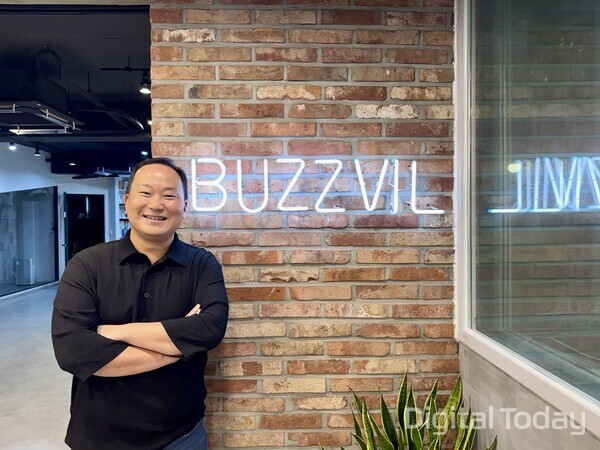
[DigitalToday reporter Seulgi Son] "We have confirmed that AI adoption markedly boosts individual productivity. But to raise organisational productivity, you need to redesign the organisation’s workflow itself, like rewiring a conveyor belt."
Kwanwoo Lee (이관우), CEO of Buzzvil, pointed to organisational redesign as the core of AI transformation (AX). He said companies must go beyond adding AI tools to existing work and instead rebuild roles and ways of working to fit AI, breaking down boundaries between job groups.
Buzzvil is accelerating AX as part of changes it is pursuing on the business side.
Buzzvil, which has run a reward advertising business, is expanding into an "interaction AI agent" that provides different ad content, missions and rewards depending on user characteristics. Lee said, "To build these products well, our organisation needs to become the one that interacts most early with AI agents."
As a first step in AX, the company created an environment in which employees can use AI sufficiently. It supports AI tools needed by each job group without limits on type or usage volume, and it also built a monitoring dashboard that lets all employees check token usage. It set a quantitative goal early this year to raise companywide token usage to 5 times the level at the start of the year, but usage had already risen 10-fold in the first half.
For a startup with limited funding and staff, deliberately increasing AI usage is a significant investment. Concern was also raised within the finance organisation about rapidly rising costs.
Lee said, "If you think of it as working with a brain next to you that is better than your own, is there any reason to save money on that?" He added, "We saw it as a matter of life and death for us."
After using AI sufficiently, the company identified areas where the effect was confirmed and spread them across the organisation. Lee said he believed optimisation can come only after extensive use, and explained that he focused on disseminating use cases with proven results throughout the organisation.
The productivity gains showed up in concrete figures. The number of code contributions by the design organisation rose to 177 in the second quarter from 10 in the first quarter. Some user experience (UX) tasks that used to take more than a day were also cut to around 30 minutes.
There were also examples of cost savings. Buzzvil replaced a global customer relationship management (CRM) solution it had used for about 12 years with its own system. After a single developer used AI to build the replacement in about 2 weeks, the company switched over after reviews by the sales organisation and quality assurance (QA) and testing, cutting annual fees by about 100 million won.
After that, it put the brakes on moves in other organisations to build external software-as-a-service (SaaS) tools in-house. It judged that it must consider maintenance burdens and sustainability from internal development.
AI was also used to upgrade the existing business. By improving an advertising product that had seen no major changes for a long period due to a lack of development resources through hackathons and other efforts, revenue in that product category rose about 170 percent in the second quarter from the fourth quarter of last year.
Lee said the next stage is organisation-wide productivity. He said it must go beyond faster individual work and reconfigure roles and work processes themselves to fit AI.
For example, the design organisation was redesigned from a previous 방식 of creating outputs and handing them to developers into an organisation that plans and codes directly. As companywide data became available for anyone to query and analyse directly, data analysts with reduced roles were also shifted to product managers (PM) in charge of other products.
Lee said that in this process, he prioritises expanding each member’s capabilities over reducing headcount. He said that in one-on-one interviews he frankly tells employees, "Your job could disappear in 6 months," while also thinking together about how to broaden roles to remain competitive in the AI era.
Lee said, "I think it is also the CEO’s role to help members in positions that could disappear grow and become competitive." At Buzzvil, there have been at least 5 cases of people switching from non-development roles to developers.
The process of spreading AI use across the organisation is also led by employees. An "AI committee" formed voluntarily by staff helps non-developers set up an initial environment for using AI and shares the latest use cases. About 40 percent of participants in an in-house hackathon were from non-development roles, and the company also supports AI usage costs for personal toy projects unrelated to company work.
This approach is also aligned with Buzzvil’s "self-leader" culture, which it has emphasised since its early days. Rather than building only the capabilities the company needs, it places importance on each member growing into a self-directed talent. Lee directly advising on business ideas or investing in employees who want to start businesses is in the same context.
In fact, entrepreneurs from Buzzvil have created the office worker community "Blind", the alarm app "Alami", the brand aggregator "Next Chapter", and Coupang’s price comparison service "Polcent", among others.
Lee said, "In the first half of this year, not a single developer changed jobs, which is the first time since the company was founded." He explained that an environment where AI tools can be used without limits and work methods can be tested directly served as a merit for developers during the AI transition period.
He forecast that boundaries between job groups will become even less distinct. Lee said, "Proficiency in handling AI tools will become expanded expertise," and added, "It is no longer an era in which you have to choose between breadth and depth. It has become an era in which you can have sufficient depth across multiple areas."
 Seulgi Son
sageson@d-today.co.kr
Seulgi Son
sageson@d-today.co.kr