
[Digital Today reporter Jinju Hong] Waymo co-CEO Dmitri Dolgov (드미트리 돌고프) pointed to limits in vision-only self-driving that relies only on cameras and artificial intelligence. He argued that while performance can improve quickly at first, the pace of improvement slows sharply when trying to secure the high level of safety required on real roads.
Cleantechnica, an electric-vehicle outlet, reported on Monday that Dolgov said in a recent presentation at a Y Combinator event that the safety-improvement curve for vision-only self-driving "flattens too early".
Dolgov’s central point was the problem of securing the final margin of safety in self-driving technology. Camera-based systems can rapidly boost performance in the early stage through AI training and data accumulation, but other problems arise when they must reliably handle the wide range of unusual situations that occur on real roads.
Self-driving vehicles must make safe decisions not only in typical driving situations but also in unpredictable conditions such as sudden obstacles, complex intersections and severe weather. Dolgov said what matters in this process is how effectively the system detects and responds to rare edge cases with a very low likelihood of accidents, rather than average driving performance.
To address this, Waymo has adopted a multi-sensor approach that uses lidar and radar in addition to cameras. The structure is designed so each sensor perceives the surroundings differently, and one sensor’s judgment can be supplemented or verified by another.
The remarks are seen as reiterating Waymo’s long-held technical strategy. Dolgov viewed it as difficult to solve self-driving safety simply by raising the performance of AI models. He said in the service stage, sensor redundancy and a mutual verification system play an important role in improving safety.
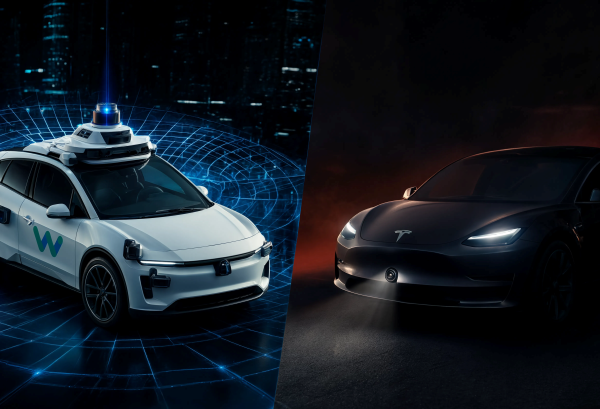
Competition continues in the autonomous driving industry over sensor configurations. Some companies, including Tesla, are focusing on reducing sensor costs and system complexity through camera-and-AI-centered approaches. Waymo, by contrast, has chosen a strategy of adding lidar and radar to secure environmental perception accuracy and a safety margin.
The difference between the two approaches ultimately leads to a balance between cost and safety. Vision-centered systems may have an advantage in mass production and cost cutting, but Waymo’s position is that additional sensors are needed to achieve the safety level required for real commercial services.
The importance of safety validation is also growing as autonomous driving expands beyond the research and development stage into commercial services that carry passengers. The ability for a vehicle to drive itself and the ability to operate a commercial service while continuously lowering accident risk are separate issues.
Dolgov’s remarks show that the competitive landscape in the autonomous driving industry is shifting from feature demonstrations to real safety validation. The article said the core of the technology race is emerging around how stably systems can respond in rare accident situations and exceptional environments, rather than simply how many roads they can drive.
A key point to watch going forward is which of the vision-only approach and the multi-sensor approach can secure higher safety in real commercial services. As autonomous driving technology enters a mass-adoption stage, the article said lowering sensor costs and how far companies can push the safety-improvement curve will become core competitiveness.
 Jinju Hong
hongjj@d-today.co.kr
Jinju Hong
hongjj@d-today.co.kr