
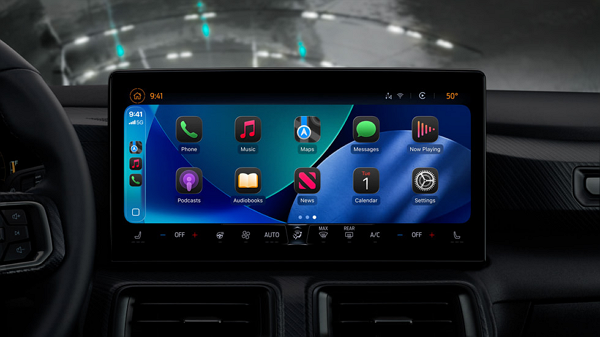
[DigitalToday reporter Jinju Hong] Tesla, Rivian and General Motors (GM) are cited as major automakers that still do not support Apple’s in-car interface CarPlay.
IT outlet 9to5Mac reported on Aug. 7 that all three are maintaining positions that exclude or limit CarPlay, citing their own in-vehicle software strategies.
Among the three, Tesla is most often mentioned as the company most likely to change. Tesla has designed its in-car infotainment experience around its own software and has never officially supported CarPlay. In November 2025, reports said Tesla was actively developing CarPlay support and could launch it within a few months.
Even after that, no actual rollout took place. In February, Mark Gurman said Tesla and Apple were working together to improve the experience when using Apple Maps with Tesla’s self-driving functions. Apple demonstrated in a June developer session that related changes were included in iOS 26.4, but Tesla’s CarPlay implementation has not yet been confirmed.
Even if Tesla introduces CarPlay, it is unlikely that CarPlay would replace the entire vehicle screen. The format being discussed is to place CarPlay like a window within Tesla’s overall interface. It would be closer to a compromise that keeps Tesla’s own software while connecting only some functions to Apple’s ecosystem.
Rivian, by contrast, is classified as a company unlikely to introduce CarPlay. Rivian executives have repeatedly said they have no plans to add CarPlay. Rivian CEO RJ Scaringe (RJ 스캐린지) said users should not have to switch between Rivian’s infotainment system and CarPlay, and that all functions should be handled by default within Rivian’s platform.
Scaringe reaffirmed the same stance this year after an interview in October last year. He said creating consistency across multiple platforms is “very difficult”. A strategy to integrate the in-car experience into a single operating system is seen as the core logic for excluding CarPlay.
Rivian’s recent comments were more hardline. Software chief Wassym Bensaid (와심 벤사이드) argued that as in-car artificial intelligence integration deepens, the CarPlay debate itself could lose meaning. “If this level of deep AI integration becomes possible in the vehicle, the CarPlay debate becomes completely useless,” he said. Rivian has made clear it will design the experience around the vehicle’s own software and AI rather than smartphone integration.
GM is the case with the longest-running conflict over CarPlay. GM announced in March 2023 that it would exclude CarPlay from future electric vehicles. At the time, GM explained it could further improve charging and self-driving functions and secure more data on how drivers use those functions.
Over the past 3 years, GM has continued to defend the decision. It has also claimed that removing CarPlay improved driver safety. Last year, it went a step further and unveiled plans to gradually reduce support for CarPlay and Android Auto in future internal combustion engine vehicles as well. The policy, previously limited to EVs, is expanding across the product lineup.
What these three companies have in common is that they do not want to hand over control of vehicle software to smartphone platforms. Even if CarPlay has become a consumer-preferred feature, their strategy is for automakers to directly control key experiences such as in-vehicle data and function integration, links to self-driving and AI application.
Their approaches differ. Tesla still has the possibility of limited adoption, while Rivian is repeatedly stating its refusal officially. GM is moving in the direction of widening the scope of support cuts. As a result, consumers who view CarPlay as a must-have feature are likely to remain in a situation where they need to weigh these companies’ software policies at the brand selection stage.
 Jinju Hong
hongjj@d-today.co.kr
Jinju Hong
hongjj@d-today.co.kr