
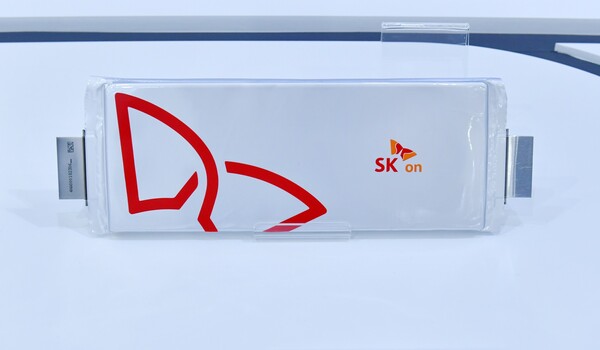
Pouch-type batteries are being called up again in defense and robotics. As demand for electric vehicles slows, battery companies are expanding into defense, robots and energy storage systems, increasing demand from areas that require different conditions than cylindrical and prismatic formats. But adoption is split by the level of thermal runaway management, and demand appears to be shifting first to companies that hold thermal management materials.
Industry officials said on Aug. 10 that pouch-type cells outperform cylindrical and prismatic cells in energy density and design flexibility. Because the cell can be made thin, it can be fitted into tight and irregular spaces. That suits areas such as robots, wearables and military equipment, where volume and weight directly affect performance. But because the casing is not a metal can, if one cell collapses, heat can spread quickly to adjacent cells, a limitation that has long been cited. Some assessments say this vulnerability also helped keep pouch-type cells from gaining a stronger foothold in the EV market.
All-solid-state batteries, a cell-level solution, are still far off. Samsung SDI unveiled a sample of a pouch-type all-solid-state battery aimed at physical AI such as humanoid robots for the first time at InterBattery 2026 and said it would mass-produce it in the second half of 2027, but even that is the earliest timetable among South Korea's three major battery makers. LG Energy Solution plans to commercialise an anode-free all-solid-state battery for robots in 2030, and SK On plans to commercialise a sulphide-based all-solid-state battery in 2029. The industry sees the remaining 3 to 4-year gap as something that safety design for existing form factors must fill.
That is why recent competition is playing out outside the cell, not within it. LG Chem has entered the battery safety materials market with a thermal runaway delay engineering plastic called SFB and Nexula, an aerogel-based thermal barrier material. It aims to pre-empt the thermal management area with an integrated safety solution combining the two materials. When exposed to flames, SFB changes its surface into a hard, dense barrier, slowing the spread of flames and pressure.
The company said the material is lightweight and workable, increasing design flexibility for battery packs. Nexula physically blocks heat diffusion between cells, between modules and inside packs. Using the two materials together creates a dual structure that delays and blocks heat. SFB was recognised as a material that responds to the global trend of tighter heat-transfer regulations and won the InterBattery Awards in the reliability and safety and sustainability categories at InterBattery 2026.
◆ Spotlight from defense including submarines; high material costs are a hurdle
Defense is where thermal runaway management technology is most likely to translate into revenue first. The Korea IR Council's Corporate Research Center forecasts that ITM Semiconductor will generate about 20 billion won in revenue per submarine from medium-to-large battery packs for export submarines from 2027. It expects the number of related export submarines to reach 10 over the following years. The project began after Hanwha Aerospace was selected in the second half of 2023 as the developer for an export-submarine lithium battery system under a weapons system manufacturing and development support programme run by the Defense Acquisition Program Administration's Institute of Defense Technology Promotion. ITM Semiconductor was also named as a cell development specialist company for the project.
Submarines are moving to lithium batteries for capacity and noise reasons. Existing submarines charged lead-acid batteries using diesel engines and then ran propulsion motors on that power. Next-generation submarines require larger capacity and lower noise, which are hard to meet with lead-acid batteries. But deploying lithium batteries presupposes explosion prevention devices. A battery management system adjusts voltage and current in advance to remove explosion risk factors, and in lithium batteries for submarines it is closer to an entry condition than an option. The Corporate Research Center said the submarine battery pack business is likely to have relatively high profitability because its revenue scale is large and the technological difficulty is high.
Demand is also emerging in the robotics industry. Mirae Asset Securities said LG Electronics unveiled the Cloi home robot and a robot actuator called Axiom at CES 2026, and presented a plan to sell them externally in 2027. That is a path that is followed by demand for robot cells and packs. The same direction is driven by an increase in high-density, high-output environments such as data center battery backup units and grid energy storage systems. Mirae Asset Securities forecast profitability at LG Chem's advanced materials division would improve toward the fourth quarter, citing rising separator sales for ESS among its reasons.
The remaining challenge is cost. Prices need to fall to move into areas supported by volume, such as ESS. Mass production technology and compatibility with other form factors must also be resolved. How far thermal management materials expand their adoption over the next few years until all-solid-state batteries enter mass production is expected to shape the market structure that follows. An industry official said, "Defense and robots do not have large volumes but have high safety requirements, so they can bear material unit costs, but mass production may take time."
 Dae-gun Seok
d2dg@d-today.co.kr
Dae-gun Seok
d2dg@d-today.co.kr